
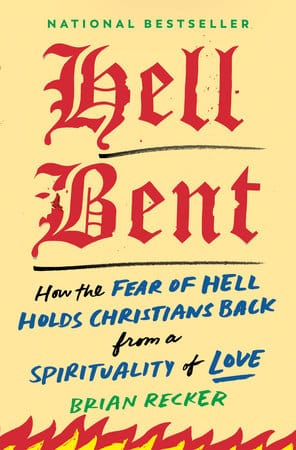
Brian Recker’s book “Hell Bent” was captivating, for one simple reason — it goes directly again a core tenant that most people (including myself) were taught as part of Christianity. In short, Recker believes that our common idea of hell simply doesn’t exist, and he gives great logical and Biblical support to back his claims.
The Biblical support is rather complex, so I encourage you to read the book for most of that, but here’s his basic idea around that:
There is no word for hell in the Bible, not really. There are a few words that are translated into English as “hell,” but not a single one of them actually means hell in the way we think about it.
However, the logical arguments are quite persuasive as well. For example:
If hell is real and God punishes people for failing to be in a proper relationship with God, then connection to God is not about growing in God’s love; it is about avoiding God’s punishment. And if you ask any therapist or relationship expert, What do you call a relationship where you’re not allowed to leave or the other person will punish you? they will tell you: That’s a toxic relationship.
He’s not wrong.
He shares a similar thought later in the book, with:
A God who is unrelentingly forgiving in life cannot become a merciless tyrant in death. A story about a God whose steadfast love endures forever cannot end with most of God’s precious creatures suffering in hell. A God who is “compassionate and gracious, slow to anger, abounding in love” (Psalm 103:8) and who “does not treat us as our sins deserve or repay us according to our iniquities” (Psalm 103:10) will not, upon our death, suddenly unload an eternity of torment on us for those same iniquities. Hell would create a self-contradictory picture of God. Thankfully, that is not the God revealed in the Bible, and that is not the story the Bible is telling.
He also talks a lot about “the world”. The Bible says many times that Jesus died “for the world”, so what does that mean? Shouldn’t that cover everyone? As Recker says in the book:
It remains unclear to me why Jesus’s payment only works if we believe in it, since the Bible says repeatedly that Jesus died for the sins of the whole world.
John 14:6
As I was reading the book, John 14:6 came to mind. If you’re not familiar with it, it says “Jesus said to him, “I am the way, and the truth, and the life; no one comes to the Father but through Me.” It sounds like a compelling case of “Believe in Jesus or you don’t get to heaven”. He shares a bit about that verse from Buddhist (and therefore hell-bound?) Thich Nhat Hanh, who says:
When Jesus said “I am the way,” he meant that to have a true relationship with God, you must practice his way.…His life, which is the way. If you do not really look at his life, you cannot see the way. If you only satisfy yourself with praising a name, even the name of Jesus, it is not practicing the life of Jesus. We must practice living deeply, loving, and acting with charity if we truly wish to honor Jesus.
Or you may wonder about “The Great Commission” (from Mark 16:15, which says to “Go into all the world and preach the gospel to all creation“). Recker’s thoughts on that:
In the Great Commission, Jesus said to make disciples and to teach them what He commanded. And what did Jesus command? Jesus summarized all the commands of scripture as loving God, and loving your neighbor as yourself.
It’s an eye-opening book, and I’ve been thinking about it a lot lately. Here’s a five-minute overview from Reading Refresh for a bit more:
It’s a nuanced look at things, and no overview can really unpack the full conversation. I highly recommend checking out his book (get it on Amazon here) to understand his entire perspective and see if it affects your views at all.



Well, OK, since you called me out by name, I guess I need to weigh in :). I have to say up front, I haven’t read this book, and it’s not high on my list of future reads, so I’m just going to respond from your description. Hope that’s OK.
My first thought is that this strikes me a bit like the deconstructionists, who are trying to legitimize why they are backing away from traditional Christianity. I instantly thought of Alisa Childers’ book, ‘Another Gospel?’ (https://amzn.to/3ZHPcLf) which I’ve read several times. There are people, apparently a lot of them, who sometimes call themselves “Progressives,” who want to give a new view to Christianity. Please don’t misunderstand, I’m all for trying to make Christianity easier to understand, and if I ever write a book (no plans), that will be a big part of it! Christianity can be hard! Fortunately, some of us … or maybe it’s just me … sort of like the wrestling with it part! The danger of “clarifying” Christianity is the risk of mis-stating.
Alisa has another book, ’The Deconstruction of Christianity,’ (https://amzn.to/4aEGe6s) that goes a lot deeper. If that’s something you’re wrestling with, it’s a great book. If you are a consistent studier of the Bible, it’s probably not a book you need to read. A key of both of her books is to be clear you know what the Bible says so you can tell when somebody is saying something that’s just a little off. Sadly, a lot of Christians today don’t recognize error. Remember, when Satan tempted Jesus, he used scripture. Well, almost. I don’t remember who first came up with this, but an approximate quote: I can prove almost any point I want if I use scripture taken out of context.
I concur with the issue that Greek doesn’t have our word ‘hell.’ What if we made up a new word, maybe ‘Tark,’ and use that instead? Since nobody uses that word , it’s a less wrong translation. I also have issue with the translations that give us the words ‘hope’ and ‘believe’ which fall way short of what the Greek intended. That doesn’t make me want to throw out everything, though.
Regardless of the word we use (funny how I just Made up Tark and now I’m liking it!) Jesus was pretty clear that there is a place where some will go and it’s not a good place and it’s well worth avoiding. And He gave us some pretty clear instructions on how to avoid Tark, although those instructions take a little more digging than most of us want to do.
My bottom line, and your mileage may vary: I believe there is a literal hell and a literal heaven. And there is not a lot of biblical description of either of them! There’s a lot of description of each of them in literature and movies. And a lot of those are more fun to read or watch than the Bible. Should we let that replace real scripture? That’s a slippery slope. Having said that, I still have some non-biblical theology I like to use sometimes, such as rock and roll theology: there’s a highway to hell, but only a stairway to heaven. That might imply the numbers that will end up each place.
Slightly related: I had a bit of a conversation with a Catholic friend the other day about purgatory. Frankly, I *love* the idea of purgatory! I would vote for it. The scriptural evidence for purgatory is pretty thin and inconsistent. Some will disagree. That can lead to some fun conversations.