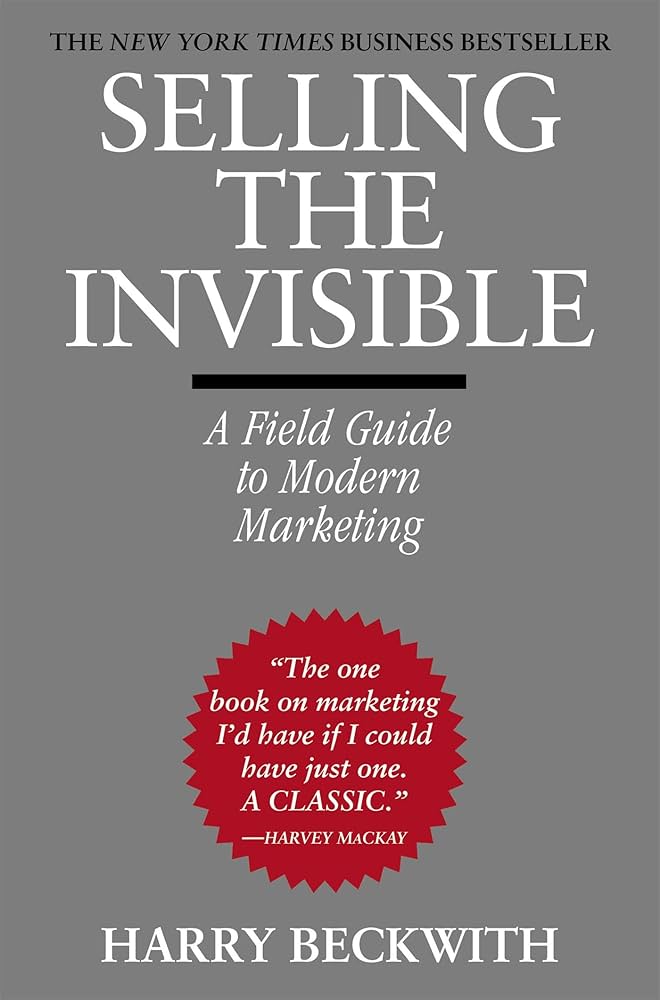
There is a unique challenge when it comes trying to market services – things you can’t see, touch, or try before buying. Unlike products, services are essentially promises that someone will do something for you. Traditional product marketing often fails for services because prospects can’t evaluate what they’re buying until after they’ve bought it. “Selling the Invisible” helps unpack all of that.
Check out my video overview of the book here, or read on to see some of my notes.
Getting Started
The Greatest Misconception about Service Marketing
The first step in service marketing is your service.
A World on Hold
First, before you write an ad, rent a list, dash off a press release—fix your service.
The Lake Wobegon Effect: Overestimating Yourself
Assume your service is bad. It can’t hurt, and it will force you to improve.
These Cartoons Aren’t Funny
Forget the excuses, and remember McDonald’s.
Let Your Clients Set Your Standards
In advertising, when most creative people say, “That’s a really good ad,” they don’t mean that the ad might build the client’s business. They just mean that it has a good headline, good visual—it’s good. Neat. Cool.
Ask: Who is setting your standards—your industry, your ego, or your clients?
Bad News: You Are Competing with Walt Disney
Ignore your industry’s benchmarks, and copy Disney’s.
The Butterfly Effect
Remember the Butterfly Effect. Tiny cause, huge effect.
A Butterfly Named Roger
Be a Roger, and hire Rogers. Flap your wings.
To Err Is an Opportunity
Big mistakes are big opportunities.
The Ad-Writing Acid Test
Write an ad for your service. If after a week your best ad is weak, stop working on the ad and start working on your service.
The Crash of Delta Flight 1985-95
Marketing is the brains of service marketing. If the brain fails, the heart soon will fail.
Getting Better vs. Getting Different
Don’t just think better. Think different.
The First Rule of Marketing Planning
Always start at zero.
The Possible Service
Create the possible service; don’t just create what the market needs or wants. Create what it would love.
Surveying and Research: Even Your Best Friends Won’t Tell You
Even Your Best Friends Won’t Tell
Ask.
But They Will Talk behind Your Back
Have a third party do your surveys.
Why Survey?
Survey, survey, survey.
The Letterman Principle
Unless you are confident that you can interpret them, Beware of written surveys.
Frankly Speaking: Survey by Phone
For a dozen reasons, conduct oral surveys, not written ones.
The One Question You Should Never Ask
Never ask “What don’t you like?”
Focus Groups Don’t
You’re selling individuals. Talk to individuals.
Marketing Is Not a Department
Marketing Is Not a Department
More than half of all Japanese companies do not even bother to have marketing departments, because they believe that everyone in the company is part of the marketing.
Marketing is not a department. It is your business.
Marketing Myopia
It’s hard to see the real scope of your business. Ask for help.
Tunnel Vision
Get out, climb out, have someone pull you out of the tunnel.
Start with You and Your Employees
Review every step—from how your receptionist answers to the message on the bottom of your invoices—and ask what you could do differently to attract and keep more customers.
Every act is a marketing act. Make every employee a marketing person.
What Color Is Your Company’s Parachute?
In planning your marketing, don’t just think of your business. Think of your skills.
What Are You Really Selling?
Then McDonald’s came along and figured out that people weren’t buying hamburgers. People were buying an experience.
- This was in comparison to Burger King and their flame-broiled burgers, which were better but simply didn’t move the needle.
Maybe you think prospects in your industry are looking for hamburgers. Chances are that they want something else. The first company to figure out what that is wins.
Find out what clients are really buying.
One Thing Most Experts Don’t Know
Most companies in expert services—such as lawyers, doctors, and accountants—think that their clients are buying expertise. But most prospects for these complex services cannot evaluate expertise; they cannot tell a really good tax return, a clever motion, or a perceptive diagnosis. But they can tell if the relationship is good and if phone calls are returned. Clients are experts at knowing if they feel valued.
In most professional services, you are not really selling expertise—because your expertise is assumed, and because your prospect cannot intelligently evaluate your expertise anyway. Instead, you are selling a relationship. And in most cases, that is where you need the most work.
If you’re selling a service, you’re selling a relationship.
Who Is Your Client?
Before you try to satisfy “the client,” understand and satisfy the person.
With Whom Are You Really Competing?
Your real competitor often is sitting across the table. Plan accordingly.
Hit ‘Em Where They Ain’t
Go where others aren’t.
The Adapter’s Edge
Make technology a key part of every marketing plan.
Study Your Points of Contact
Then, ask: What are we doing to make a phenomenal impression at every point?
Don’t squander one point of contact. It may be your only one.
Study each point of contact. Then improve each one—significantly.
Life Is Like High School
In large part, service marketing is a popularity contest.
Voted Best Personality
Be professional—but, more importantly, be personable.
Planning: The Eighteen Fallacies
Fallacy: You Can Know What’s Ahead
You never know. So don’t assume that you should. Plan for several possible futures.
Fallacy: You Can Know What You Want
Second, don’t value planning for its result: the plan. The greatest value of the plan is the process, the thinking that went into it.
- This is where AI can be very problematic.
Fallacy: Strategy Is King
Do Anything.
Fallacy: Build a Better Mousetrap
Execute passionately. Marginal tactics executed passionately almost always will outperform brilliant tactics executed marginally.
Fallacy: There’ll Be a Perfect Time (The Bedrock Fallacy)
Do it now. The business obituary pages are filled with planners who waited.
Fallacy: Patience Is a Virtue (The Shark Rule)
Act like a shark. Keep moving.
Fallacy: Think Smart (The Crab Concept)
Think dumb.
The Fallacy of Science and Data
Mistrust “facts.” And don’t approach planning as a precise science. Planning is an imprecise art.
The Fallacy of Focus Groups
Beware of focus groups; they focus only on today. And planning is about tomorrow.
The Fallacy of Memory
In planning, Beware of what you think you remember.
The Fallacy of Experience
Have a healthy distrust of what experience has taught you.
The Fallacy of Confidence
The people tested answer a series of questions, and then answer this question about each answer: “From one to a hundred percent, how certain are you about this answer?”
What happens?
On the answers of which people say they are totally—100 percent—certain, they are right only 85 percent of the time.
In other words, 15 percent of the time you think you are absolutely certain you are absolutely wrong.
In most services, that 15 percent error—those wrong but widespread assumptions that everyone in the company is making—is the most leverageable part of your business. Find it, and attack it.
Jay Chiat carries a note in his pocket. The note reminds him that whenever he is in an argument he should remember the note’s three words:
Maybe he’s right.
Beware of the overconfidence bias. Maybe he’s right.
Fallacy: Perfection Is Perfection
And perhaps most important, will all that excellence really benefit the person for whom it is intended? Will the prospects or customers care? Will it be worth the cost to them?
Don’t let perfect ruin good.
Fallacy: Failure Is Failure
Start failing so you can start succeeding.
The Fallacy of Expertise
Don’t look to experts for all your answers. There are no answers, only informed opinions.
The Fallacy of Authority
The bumper stickers are right: Question Authority. Question alphas.
The Fallacy of Common Sense
But in planning, people do not stumble in reaching conclusions. They err in establishing their premises.
- A good answer is useless if it’s the wrong question.
Common sense will only get you so far. For inspiring results, you’ll need inspiration.
The Fallacy of Fate
You gotta believe.
Anchors, Warts, and American Express: How Prospects Think
Yeah, but I Like It
Appeal only to a prospect’s reason, and you may have no appeal at all.
How Prospects Decide: Choosing the Familiar
The evidence suggests that it is better to be known badly than not to be known at all. This is due to a human trait called attribute forgetting. Let’s say you hear something negative about a company. As time passes you tend to forget that negative information—you forget the attributes—and remember only the company name.
Familiarity breeds business. Spread your word however you can.
How Prospects Decide: Using the Most Recent Data
Take advantage of the Recency Effect. Follow up brilliantly.
How Prospects Decide: Choosing “Good Enough”
Forget looking like the superior choice. Make yourself an excellent choice.
Then eliminate anything that might make you a bad choice.
The Anchoring Principle
Identify and polish your anchors.
Last Impressions Last
Each impression you make will—temporarily, at least—be your last. So make it strong.
Risky Business
Yes, build the quality into your service—but make it less risky, too.
You Have Nothing to Fear but Your Client’s Fear Itself
The best thing you can do for a prospect is eliminate her fear. Offer a trial period or a test project.
Show Your Warts
Tell the truth. Even if it hurts, it will help.
Business Is in the Details
The more similar the services, the more important the differences.
Accentuate the trivial.
The More You Say, The Less People Hear: Positioning and Focus
Fanatical Focus
Stand for one distinctive thing that will give you a competitive advantage.
The Fear of Positioning
To broaden your appeal, narrow your position.
Lesser Logic
In your service, what’s the hardest task? Position yourself as the expert at this task, and you’ll have lesser logic in your corner.
Halo Effects
Say one positive thing, and you will become associated with many.
No Two Services Are the Same
If you cannot see the differences in your service, look harder.
Position Is a Passive Noun, Not an Active Verb
“We’re Number Two,” Avis ads repeated for years. “We try harder.” People believed it. Sales soared.
Don’t start by positioning your service. Instead, leverage the position you have.
Creating Your Positioning Statement
Who: Who are you?
What: What business are you in?
For whom: What people do you serve?
What need: What are the special needs of the people you serve?
Against whom: With whom are you competing?
What’s different: What makes you different from those competitors?
So: What’s the benefit? What unique benefit does a client derive from your service?
Ask yourself these seven questions—and have seven good clear answers.
Creating Your Position Statement
Your position is all in people’s minds. Find out what that position is.
How to Narrow the Gap between Your Position and Your Positioning Statement
If the gap between your position and your positioning statement is too big, your customers won’t make the leap. Keep your steps small.
If That Isn’t Our Positioning Statement, What Is It?
Craft bold dreams and realistic positioning statements.
Repositioning Your Competitors
Choose a position that will reposition your competitors; then move a step back toward the middle to cinch the sale.
Positioning a Small Service
In positioning, don’t try to hide your small size. Make it work by stressing its advantages, such as responsiveness and individual attention.
Focus: What Sears May Have Learned
If you think you can afford not to focus, think of Sears.
Focus and the Clinton Campaign
Focus. In everything from campaigns for peanuts to campaigns for president, focus wins.
When the Banker’s Eyes Blurred: Citicorp’s Slip
No matter how skilled you are, you must focus your skills.
What Else Positions and Focus Can Do for You
Ugly Cats, Boat Shoes, and Overpriced Jewelry: Pricing
Ugly Cats, Boat Shoes, and Overpriced Jewelry: The Sheer Illogic of Pricing
Don’t assume that logical pricing is smart pricing. Maybe your price, which makes you look like a good value, actually makes you look second-rate.
Pricing: The Resistance Principle
Setting your price is like setting a screw. A little resistance is a good sign.
Avoiding the Deadly Middle
The premium service and the low-cost provider occupy nice niches all by themselves. If you are priced in between, however, you are competing with almost everyone. And that’s a lot of everyones.
Beware of the Deadly Middle.
The Low-Cost Trap
Beware of the rock bottom.
Pricing: A Lesson from Picasso
A woman was strolling along a street in Paris when she spotted Picasso sketching at a sidewalk café. Not so thrilled that she could not be slightly presumptuous, the woman asked Picasso if he might sketch her, and charge accordingly.
Picasso obliged. In just minutes, there she was: an original Picasso.
“And what do I owe you?” she asked.
“Five thousand francs,” he answered.
“But it only took you three minutes,” she politely reminded him.
“No,” Picasso said. “It took me all my life.”
Don’t charge by the hour. Charge by the years.
The Carpenter Corollary to the Picasso Principle
A man was suffering a persistent problem with his house. The floor squeaked. No matter what he tried, nothing worked. Finally, he called a carpenter who friends said was a true craftsman.
The craftsman walked into the room and heard the squeak. He set down his toolbox, pulled out a hammer and nail, and pounded the nail into the floor with three blows.
The squeak was gone forever. The carpenter pulled out an invoice slip, on which he wrote the total of $45. Above that total were two line items:
Hammering, $2.
Knowing where to hammer, $43.
Charge for knowing where.
Value Is Not a Position
If good value is the first thing you communicate, you won’t be effective.
If good value is your best position, improve your service.
Monogram Your Shirts, Not Your Company: Naming and Branding
Monogram Your Shirts, Not Your Company
Blame IBM. IBM convinced executives that if they gave their company a fancy monogram like IBM, they would succeed like IBM.
This is like thinking that Michael Jordan’s shoes will make you like Mike.
It’s also like thinking that dinner causes midnight, because midnight always comes after dinner.
Don’t Make Me Laugh
Don’t get funny with your name.
To Stand Out, Stand Out
Generic names encourage generic business.
Tell Me Something I Don’t Know
Never choose a name that describes something that everyone expects from the service. The name will be generic, forgettable, and meaningless.
Distinctive Position, Distinctive Name
Be distinctive—and sound it.
What’s in a Name?
If you need a name for your service, start with your own.
Names: The Information-per-Inch Test
Give every name you consider the Information-per-Inch Test.
The Cleverness of Federal Express
Use Federal Express as your standard, and ask: How much does your name communicate, how fast? Are you using color effectively? Is it conveying the same message as your name?
The Brand Rush
In service marketing, almost nothing beats a brand.
Aren’t Brands Dying?
Brands are alive—and you could use one.
The Warranty of a Brand
A service is a promise, and building a brand builds your promise.
The Heart of a Brand
Invest in and religiously preach integrity. It is the heart of your brand.
What Brands Do for Sales
Third, consider the plight of the typical non-branded service. To justify her choice of a non-branded service, a prospective client often must schedule follow-up presentations with the key people in her company (or her spouse, if it is a consumer service). Frequently, a nonbranded service will spend more on this lengthy selling process than the initial project is worth. Branded services rarely face that expense. In fact, prospects routinely choose brand-name services virtually sight unseen, so brands take less time and expense to sell.
Make selling easier, faster, and cheaper. Build a brand.
Stand by Your Brand
Never underestimate the value of your brand or the difficulty in creating a new one.
The Four-Hundred-Grand Brand
A brand is money.
Brands in a Microwave World
Give your prospects a shortcut. Give them a brand.
Brands and the Power of the Unusual
To speed up the building of your brand, choose an unconfusable name.
Brands and the Baby-sitter
Building your brand doesn’t take millions. It takes imagination.
How to Save $500,000: Communicating and Selling
Communicating: A Preface
Make the service visible, and make the prospect comfortable.
Fran Lebowitz and Your Greatest Competitor
Your first competitor is indifference.
The Cocktail Party Phenomenon
Say one thing.
The Grocery List Problem
Saying many things usually communicates nothing.
Give Me One Good Reason
Meet your market’s very first need: Give it one good reason.
Your Favorite Songs
After you say one thing, repeat it again and again.
One Story Beats a Dozen Adjectives
Don’t use adjectives. Use stories.
Attack the Stereotype
Attack your first weakness: the stereotype the prospect has about you.
Don’t Say It, Prove It
Good basic communicating is good basic marketing.
Build Your Case
Create the evidence of your service quality. Then communicate it.
Tricks Are for Kids
Gimmicky headlines, swimsuit models, direct marketing tricks—they’re all a form of bait and switch.
And these tricks say one thing. They tell your prospects you are willing to trick them.
And that tells your prospects that you’ll try to trick them again.
No tricks.
The Joke’s on You
If you think your promotional idea might seem silly or unprofessional, it is.
Being Great vs. Being Good
Prospects do not buy how good you are at what you do. They buy how good you are at who you are.
Superiority
Convey that you are “positively good.”
The Clout of Reverse Hype
Far better to say too little than too much.
The First Banks Lesson: People Hear What They See
Watch what you show.
Make the Invisible Visible
Make sure people see who you are.
The Orange Test
Seeing is believing. So check your peel.
Our Eyes Have It: The Lessons of Chicago’s Restaurants
Watch—and perfect—the visual clues you send.
How to Save Half a Million
Repeat yourself visually, too. It makes you look more organized and professional, and easier to remember.
The Hearsay Rule
Give your marketing a human face.
Metaphorically Speaking: The Black Hole Phenomenon
The words “black hole” changed how people thought. Most important, the words helped people get the idea of a gravitationally completely collapsed object.
If you are selling something complex, simplify it with a metaphor.
The Generative Power of Words: The Gettysburg Address
Remember Gettysburg, and the generative power of words.
A Robe Is Not a Robe
Sometimes, it’s all in how you say it.
Balderdash
You don’t listen to clichés. Your clients won’t either.
Improve the Silence
Get to the point or you will never get to the close.
What’s Your Point?
Tell people—in a single compelling sentence—why they should buy from you instead of someone else.
The Vividness Effect
In your words and pictures, make yourself vivid.
Vivid Words
“You cannot bore someone into buying your product.”
The Value of Publicity
Get ink.
Advertising Is Publicity
If you want publicity, advertise.
Advertising Begets Publicity
If you want more publicity, do more advertising.
The Essence of Publicity
If you want editors to help you, help them. Give them something interesting. Give them a story.
Inspiration from William F. Buckley
Look harder. The interest—and the story—are there.
Focus on Buying, Not Selling
Make your service easy to buy.
The Most Compelling Selling Message
Don’t sell your service. Sell your prospect.
What Blank Eyes Mean
Talk about him, not about you.
Presenting’s First Rule: Imitate Dick
You should copy him.
Mission Statements
Write a mission statement, but keep it private.
What a Mission Statement Must Be—and Must Have
Draw a clear map. And after every mission statement, add an objectives statement.
When to Can a Mission Statement
If your mission statement isn’t producing, fire it.
What Really Sells
Above all, sell hope.
Holding On To What You’ve Got: Nurturing and Keeping Clients
Relationship Accounting
Watch your relationship balance sheet; assume it is worse than it appears, and fix it.
The Day After—Why Getting the Business Can Be the First Step in Losing It
Don’t raise expectations you cannot meet.
Expectations, Satisfaction, and the Perils of Hype
A customer’s satisfaction is the gap between what the customer expects and what she gets. Service below her expectations makes her dissatisfied—and the greater the gap, the greater her dissatisfaction.
To manage satisfaction, you must carefully manage your customer’s expectations.
Your Patrons Are Saints
There is no such thing as too often, too grateful, too warm, or too appreciative.
After all she has been through—more than you know—you cannot thank your client too much.
Your parents were right. Say thank you. Often.
Thanks
Keep thanking.
Where Have You Gone, Emily Post?
The seminar hosts barely respond. They mail a four-sentence form letter to all thirteen speakers.
Do you thank people enough? Are you sure?
Poised for a Fall
Make sure the client knows.
Satisfaction and Services
Out of sight is out of mind.
Quick Fixes
Manage the Tiny Things
Sweat the smallest stuff.
One Ring
Your business starts with the first call. How good is yours?
Speed
Be fast. Then get faster.
Say P.M., Deliver A.M.
Say P.M., deliver A.M.
Note to Myself
So do something corny. Put that note by your phone.
Shoot the Message, Not the Messenger: The Fastest Way to Improve Your Sales Force
To fix your messengers, fix your message.
Personal Investment
Risk yourself.
The Collision Principle
Get out there. Almost anywhere. Let opportunity hit you.
Summing Up
Recommended Reading for Service Marketers
Most of all, however, I recommend watching a presentation by my former boss, Dick Wilson. Some things cannot be explained; they must be seen. A Dick Wilson presentation is one of them.