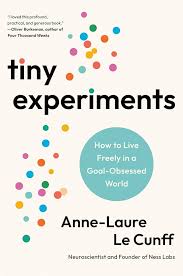
Now that I’m using Reading Refresh to keep myself up to date on books I’ve read in the past, I thought I’d share some of them as they came back up. Today is “Tiny Experiments” by Anne-Laure Le Cunff.
I’ve followed Anne-Laure Le Cunff for many years now, having written about her on here starting back in 2020, and having read her stuff well before then.
Tiny Experiments is essentially a book that encourages you to be more creative and she breaks the book down into four main sections:
- Get started by committing to curiosity.
- Keep going by practicing mindful productivity.
- Stay flexible by collaborating with uncertainty.
- Dream bigger by growing with the world.
Commit to Curiosity
While you’ll hear a lot of encouragement from the world to “follow your purpose”, Le Cunff argues against that a bit, saying that it might keep you too locked in and not curious enough. From the book:
“When we fixate on finding one singular purpose, we rule out the side quests that help us grow the most. Your life doesn’t need to follow predictable acts and arcs. The best stories are full of surprises, with colorful characters and unexpected plot twists.”
She says there are really three “scripts” that can keep you too locked in and “shackled in artificial boundaries”:
- The sequel script: when we follow our past
- The crowdpleaser script: when we follow the crowd
- The epic script: when we follow our passion
Practice Mindful Productivity
In this section, she speaks a lot about making good use of your time, using the Greek words “Chronos” and “Kairos” to unpack her ideas:
The ancient Greeks had not one but two words to speak of time. The first one, Chronos, refers to quantity. This is largely how most of us in the modern world relate to time. It is the time of clocks and calendars, of productivity tools and linear goals. The Greeks valued this qualitative view deeply, so much so that they had a second word for time: Kairos. Kairos expresses the quality, not the quantity, of time. It recognizes that each moment is unique, with a unique purpose, rather than a fixed unit to be mechanically allocated. Kairos is when you feel like this moment, right now, is perfect.
She also attacks the idea of “multitasking”, which generally isn’t a real thing:
“We fancy ourselves adept multitaskers, but studies show that our performance drops dramatically when we attempt to focus on more than one thing at a time. That’s because the human brain has an attentional bottleneck impacting both perception and action. In short, our efforts to get more done actually slow us down.”
Collaborate with Uncertainty
There were two big things that stood out to me in this section. The first is the continual call to leave time to think about thinking, where she says:
“Our ancestors’ daily routines included organic opportunities to shape their inner world—on long walks, in meditative moments while completing repetitive tasks such as sewing and tending to crops, or in nightly reflection when praying before bed. But we in the present day have largely lost those quiet natural pauses. Instead, we grind on a near-constant flood of social media and emails. This leaves little space for thinking, let alone thinking about thinking.“
She also shares her idea for “Plus Minus Next”, which I’ve incorporated into my weekly previews:
The tool is called Plus Minus Next, and it does what it says on the tin with just three columns; positive observations go in the first column (Plus), negative observations in the second column (Minus), and plans for what’s next in the last column (Next).
- Plus. Write down any accomplishment that made you proud. These could be largely work-based, but don’t neglect other areas of your life such as relationships, hobbies, and homelife.
- Minus. Identify any challenges or obstacles you faced, whether it was a difficult task at work, an unexpected setback, or an opportunity you missed. Maybe you experienced a misunderstanding in a personal or professional interaction. Maybe there are tasks you intended to complete but didn’t. Acknowledge any mistakes you made, biases you noticed, decisions you regretted.
- Next. Use the insights from both the Plus and Minus columns to shape your actions for the upcoming period. Consider strategies to foster more of the positive observations listed in the Plus column. This might involve protecting your time for work that brings you joy, seeking resources to acquire new skills, or finding ways to deepen the relationships that matter to you.
Grow with the World
This final section is largely about three powerful effects to help you grow with others:
The pooling effect: Psychologists call this transactive memory, a system where individuals develop an understanding of who knows what, enabling them to leverage the group’s knowledge and make progress more effectively.
The ripple effect: Such interactions are especially likely in what researchers call communities of practice—groups of people who genuinely care about the same issues and frequently engage to learn from one another.
The safety effect: When you lose a job, members can connect you with new opportunities. If you face a legal issue, someone may offer advisor referrals. When a family member passes away, a community can raise money to cover expenses. Beyond practical help, a community can also provide moral support.
There’s certainly a lot more to cover, as this was one of my most highlighted books ever. Grab a copy of it on Amazon if you want to check it out, or watch this seven minute overview video for a bit more.