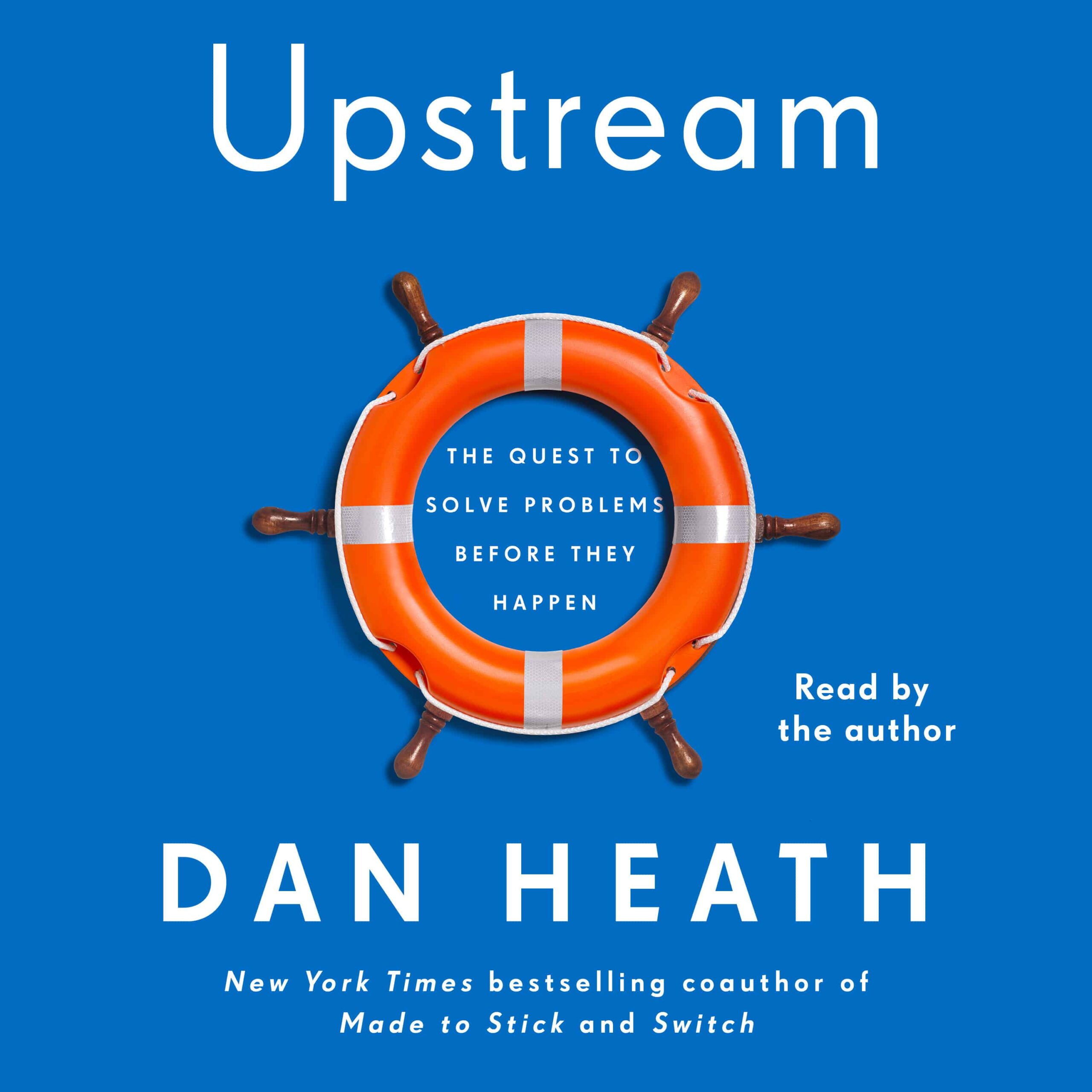
Now that I’m using Reading Refresh to keep myself up to date on books I’ve read in the past, I thought I’d share some of them as they came back up. Today is Dan Heath’s “Upstream“. This book is also available as a free flashcard deck on Ripple Recall.
Dan Heath’s “Upstream” was one of the most eye-opening books I’ve read in a long time, because it literally opened my eyes to things that are happening all around us. Most of the focus in the world is typically on downstream efforts (fixing problems) rather than upstream efforts (solving problems before they happen). Here’s how Heath explains it:
That’s one reason why we tend to favor reaction: Because it’s more tangible. Downstream work is easier to see. Easier to measure. There is a maddening ambiguity about upstream efforts. One day, there’s a family that does not get into a car accident because a police officer’s presence made them incrementally more cautious. That family has no idea what didn’t happen, and neither does the officer. How do you prove what did not happen? Your only hope, as a police chief, is to keep such good evidence of crashes that you can detect success when the numbers start falling. But even if you feel confident your efforts accomplished something, you’ll still never know who you helped.
He shares the Y2K preparation as a perfect example of this:
There’s a concept called “the prophet’s dilemma”: a prediction that prevents what it predicts from happening. A self-defeating prediction. What if Chicken Little’s warnings actually stopped the sky from falling? The Y2K bug was an example of the prophet’s dilemma. The warnings that the sky would fall triggered the very actions that kept the sky from falling.
As I shared a few years ago, I see this happening with vaccines and self-driving cars. The upstream efforts save (or will save) millions of lives, but those millions of people are unknown:
When self-driving cars become the norm, we’ll likely save 30,000 lives per year that would have otherwise died in car accidents. However, it’s also likely the the self-driving cars won’t eliminate every accident and a small number of lives will still be lost. The problem is that we’ll know those losses by name when they happen, but the 30,000 people who would have otherwise died will have no idea how fortunate they are.
We also saw this with COVID vaccines. It’s estimated that they saved roughly three million lives, but also caused a number deaths that may not have otherwise occurred (that number is widely disputed, but it’s at least the nine that died from the J&J vaccine). We know specifically who died from it, but those that were saved have no idea. Perhaps you or I might have died of COVID if we hadn’t been vaccinated, but there is no way to know for sure.
Without knowing who specifically was saved, pushing upstream efforts is very difficult.
I also liked some of his thoughts on creating upstream solutions for ourselves, including this example:
Which problems have you come to accept as inevitable that are, in fact, nothing of the kind? Maybe it’s something small: say, the irritation of finding a place to park in a crowded parking lot. I met a woman who told me about an epiphany: “I literally have a step-counter on my wrist and yet I was driving myself crazy trying to find a close space. It was madness. So now I always park in the most remote spot in the lot. I think of it as a ‘VIP spot,’ away from the other cars. I get some extra steps and don’t stress about finding a spot. It’s such a wonderful sense of relief, like I’ve purged that concern forever from my life.”
It’s a fantastic book, and I’m confident that it’ll help shape your lens for the world a little bit as well.
Grab the book on Amazon, try your hand at some Upstream flashcards on Ripple Recall, or watch this short overview video for a bit more: