“You don’t have a “biblical worldview.” You have a worldview shaped by your subculture’s interpretation of Christianity. . . . Admit influences; purge bad ones; change systems.”
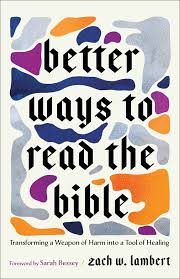
We all have lenses through which we read the Bible, and Zach Lambert’s “Better Ways to Read the Bible” helps to unpack them and show you some new lenses to use instead.
Check out my video overview of the book here, or read on to see some of my notes.
Introduction: How the Bible Beat Me Up
“When religion won’t tolerate questions, objections, or differences of opinion and all it can do is threaten excommunication, violence, and hellfire, it has an unfortunate habit of producing some of the most hateful people to ever walk the earth.”
- David Dark, The Sacredness of Questioning Everything
Putting on New Lenses
That’s when I began to see that I had learned to read the Bible through four distinct lenses that often lead to harm:
- The literalism lens: “The Bible says it, I believe it, that settles it.”
- The apocalypse lens: “It’s all gonna burn anyway.”
- The moralism lens: “Well, that’s not biblical.”
- The hierarchy lens: “Submit to authority as you submit to God.”
Their common assumptions formed the basis of what I began to call “healthy lenses”:
- The Jesus lens: “The Scriptures point to me.”
- The context lens: “The one who seeks will find.”
- The flourishing lens: “I have come that they may have life abundantly.”
- The fruitfulness lens: “By their fruit you will recognize them.”
Part 1: We All Have Lenses
1. You’re Reading It Wrong
“I have come to regard with some suspicion those who claim that the Bible never troubles them. I can only assume this means they haven’t actually read it.”
- Rachel Held Evans, A Year of Biblical Womanhood
What Is the Bible and How Does It Work?
Quiet Times and Cities on Fire
When the Bible Lets Us Down
When Church Leaves Jesus Behind
Picking Up the Bible Again
2. Some Lenses Are Better Than Others
“You don’t have a “biblical worldview.” You have a worldview shaped by your subculture’s interpretation of Christianity. . . . Admit influences; purge bad ones; change systems.”
- Samuel Perry
Is Our Good News Actually Good?
“I Have a Problem with the Bible”
Erna Kim Hackett calls this problem “Disney princess theology.” She writes,
- “As each individual reads Scripture, they see themselves as the princess in every story. They are Esther, never Xerxes or Haman. They are Peter, but never Judas. They are the woman anointing Jesus, never the Pharisees. They are the Jews escaping slavery, never Egypt. For citizens of the most powerful country in the world, who enslaved both Native and Black people, to see itself as Israel and not Egypt when studying Scripture is a perfect example of Disney princess theology. And it means that as people in power, they have no lens for locating themselves rightly in Scripture or society—and it has made them blind and utterly ill-equipped to engage issues of power and injustice. It is some very weak Bible work.”
From the book How to Think Theologically: “The biblical text does not speak for itself; every reading is someone’s interpretation of it.”
Part 2: Lenses That Inflict Harm
3. The Literalism Lens
“The Bible Says It, I Believe It, That Settles It”
“Biblical literalism has never been about being faithful to the Bible, but about weaponizing selective parts of the Bible to give a personally preferred interpretative outcome the weight of God’s full authority.”
- David Simmons
The Bible in Black and White
“True” Stories
Jesus the Storyteller
Literalism and Genesis 1-3
Other Origin Stories
Seeing God’s Character Without a Distorted Lens
Literalism and Opting Out of Christianity
4. The Apocalypse Lens
“It’s All Gonna Burn Anyway”
“If God’s solution for evil is to kill people who are evil, God didn’t need to send his Son—he could have just sent in the tanks.”
- Brian Zahnd, Postcards from Babylon
Do you remember Christian bookstores? Lifeway, Mardel, and Family Christian were the three biggest, boasting a combined 450 locations nationwide. There are only 40 or so left today, but if you wanted to know what American Christians were reading in the early 2000s, the easiest way to find out was to peruse the shelves of a Christian bookstore.
Hell Houses and Apocalyptic Trauma
The Invention of Left Behind Theology
A Better Way to Read Revelation
Much like empires of today, Rome chose war over peace, hierarchy over equality, the enrichment of a few over taking care of everyone, and it used fear, shame, and violence to maintain power.
But What About Hell?
Its Gates Will Never Be Shut
5. The Moralism Lens
“Well, That’s Not Biblical”
“When we were told to “love everybody” I had thought that meant everybody. But no. It applied to only those who believed as we did.”
- James Baldwin, The Fire Next Time
Divorce and Patriarchy
“Go and Sin No More”
Moralism and Sin
6. The Hierarchy Lens
“Submit to Authority as You Submit to God”
“Empires create their own theologies to justify their occupation. . . . This is why biblical interpretation is critical. The one who interprets assumes power.”
- Mitri Raheb, Faith in the Face of Empire
In fact, the largest Protestant denomination in the world, the Southern Baptist Convention, had been founded in 1845 to allow clergy and missionaries to continue enslaving Black people.
The First Church Fights Hierarchy
God Hates Hierarchy
Part 3: Lenses That Promote Healing
7. The Jesus Lens
“The Scriptures Point to Me”
“Even Scripture can be anti-Christ if we allow it to move us away from the way of Jesus.”
- Jeremy Duncan, Upside-Down Apocalypse
Deconstructing a Text-Centered Faith
Actor, comedian, and former conservative evangelical Rhett McLaughlin puts it even more bluntly: “Your kids are not leaving the church because you didn’t train them enough. Your kids are leaving the church because you trained them well enough to develop a sense for truth and justice. You let them read the words of Jesus, and they got it, and they’ve recognized that the church doesn’t seem to be interested in those words. They’re not leaving because they don’t know the truth; they’re leaving because they do.”
Reconstructing a Jesus-Centered Faith
This means that if something in Scripture seemingly contradicts the person, work, or teachings of Jesus, we have misunderstood, misinterpreted, or misapplied it.
What Does Jesus Care About?
I love the way Beth Moore says it: “Love God. Love one another. Love your neighbor. Love your enemy. That about covers it. In Christ’s meticulous census, the community exempt from the love of Christians has a population of exactly zero.”
8. The Context Lens
“The One Who Seeks Will Find”
“The notion that we read the New Testament exactly as the early Christians did, without any weight of tradition coloring our interpretation, is an illusion. It is also a dangerous illusion, for it tends to absolutize our interpretation, confusing it with the Word of God.”
- Justo Gonzalez, The Story of Christianity
This is what it means to take the Lord’s name in vain. It’s not about saying “Oh my god!” when you’re frustrated, although I still get onto my kids about that. Taking the Lord’s name in vain is about using God to justify subjugation and marginalization, it’s about validating violence with Bible.
I had a seminary professor who used to repeat the quip “A text without context is a pretext for a proof text.” Proof texting is using a verse or passage to prop up an ideology that Jesus and the whole of Scripture don’t actually support. This is how bigotry gets baptized.
“I Do Not Permit a Woman to Teach”
“Wives, Submit to Your Husbands”
Jesus and Paul Were Feminists
9. The Flourshing Lens
“I Have Come That They May Have Life Abundantly”
“There can be no love without justice.”
- bell hooks, All About Love
Flourishing and Liberation Theology
Although God certainly loves all of humanity equally, Scripture shows us time and time again that God pays unique attention to the poor and the oppressed.
God of Justice
If someone receives money, power, or political gain from injustice, then demonizing justice is the most effective way to ensure the perpetuation of those benefits
Liberation from Internment Camps
Flourishing for a Widow
10. The Fruitfulness Lens
“By Their Fruit You Will Recognize Them”
“For love is not what we do after we get the other things done, if we have any energy left over. Love is what we do, period. It is not how we work; it is our work.”
- Eugene Peterson, This Hallelujah Banquet
You Will Know Them by Their Fruit
Jesus and Sexual/Gender Minorities
The Old Testament and Sexual/Gender Minorities
The Early Church and Sexual/Gender Minorities
But What About the Clobber Verses?
“What the Hell Else Was I Gonna Do?”
Toxic Fruit Transformed
Conclusion: A Restored Reading
“The only clear line I draw these days is this: when my religion tries to come between me and my neighbor, I will choose my neighbor. . . . Jesus never commanded me to love my religion.”
- Barbara Brown Taylor, Holy Envy
We Need Each Other
When the Bible Becomes a Tool of Healing