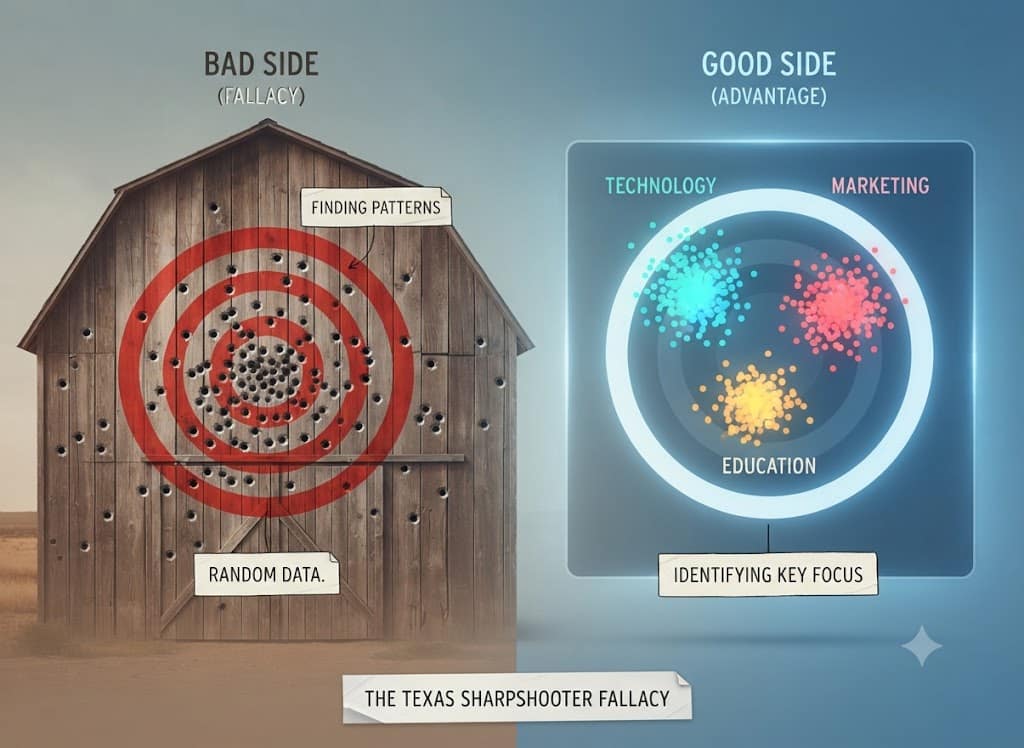
I love me a good fallacy, and the “Texas Sharpshooter” fallacy is a super interesting one. If you’re not familiar with it, here’s how Wikipedia describes it:
The Texas sharpshooter fallacy is the statistical fallacy of inferring meaning from what is essentially a random distribution of data points. It is related to the clustering illusion, which is the tendency in human cognition to interpret patterns where none actually exist, itself stemming from the tendency to underestimate the likelihood of clusters appearing in random or pseudorandom datasets.
The name comes from an anecdote about a person in Texas who fires a gun at the side of a barn, with bullets landing in a random distribution. He then paints a target around the tightest cluster of shots and claims to be a sharpshooter.
At its core, this is clearly problematic. You can find clusters in almost any dataset and most are just random groupings. As an example:
The fallacy routinely appears in the publication of data on drug efficacy, and has been recognised as being built-into many tools of drug discovery and design. A drug may have no effect yet still produce a statistically significant effect in a specific subgroup if a sufficient number of analyses are run; the effect is not real, but is rather the result of a target being drawn around a cluster of random, positive data points. The effect will disappear when the test is replicated.
So what is the good side of this? In some situations, you can use it to your advantage.
A great example is this blog. I’ve written thousands of posts over the years, covering a wide variety of topics, writing about what interests me. At any point in time, I can look at all of the posts and find the clusters to see what I tend to focus on most often, and then perhaps dig deeper into that.
I did this recently, and now when people ask what I write about I generally say “technology, marketing, and education”. I did the writing, and the circled up the topics later.
This fallacy can be used for good or bad, and knowing the difference is crucial. If you can spot the misapplications (like the drug example above) you can prevent bad decisions, and you can use it in other ways to find helpful patterns in your own work.