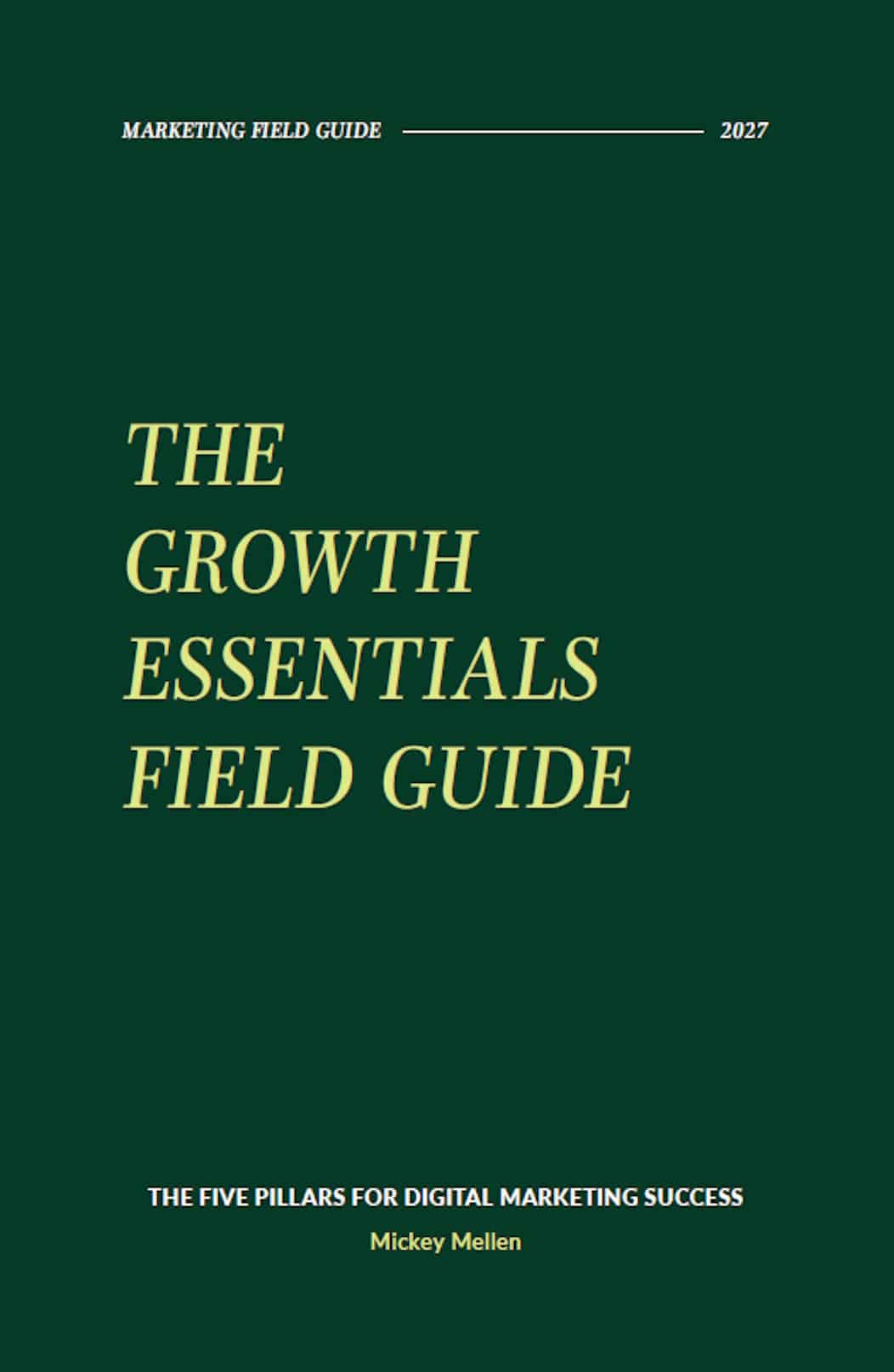
I’ve just published “The Growth Essentials Field Guide”, covering the five core areas that your small business should focus on. Today I’ll be sharing the final pillar, which is about social media.
While the book is available on Amazon, just email me and I’ll be happy to send you a copy of the EPUB file for you to load yourself. Better yet, I’ve wired up a special version of Flowstate Reader so you can just click here and read the full book immersively (text + voice) in your browser right now for free.
For you Atlanta folks, I’ll be discussing the book next Wednesday, September 16 at the Northeast Cobb Business association luncheon, so come join us there if you’re free. Here’s pillar five and my closing thoughts. Enjoy!
Pillar Five: Social Media
“Social media is just an empty vessel; you only get out of it what you put into it.” – Gary Vaynerchuk, “Day Trading Attention”
I’m calling this chapter “social media”, but that may not really be a thing anymore. Sure, there are “social” platforms that you can visit, but their overall behavior has changed dramatically. Rather than being built on the social graph to show you content from people you know and follow, the vast majority of the content you see comes from what their algorithms recommend. These days it’s more “interest media” than “social media”.
Instead of focusing on growing your follower count, focus on producing amazing content. The goal of creating amazing content always should have been a high priority, but it’s the only priority these days. The value of having “followers” has been dropping for years, and that trend will only continue. Getting more followers isn’t a bad thing, but it’s simply not nearly as valuable as it once was.
As Seth Godin has frequently said, “persistent, consistent, and frequent stories, delivered to an aligned audience, will earn attention, trust, and action.” Social media is just an empty vessel, and you’ll only get out of it what you put into it.
The shift from social media to interest media is not a great thing, but there are some advantages to it. Let’s dig in.
THE MYTHS
“You have to be a dancing influencer to be found”
I’ve talked to many companies about creating a presence for themselves on TikTok, and I’ve heard far too often that “it’s just full of dancing teenagers”. While that may often be true for the most popular content, there is a place for every kind of person and company. The difference is that your content needs to be compelling. It doesn’t need to be dancing, or music, or action, or anything specific, but it needs to be something that resonates with people.
TikTok’s algorithm is amazing and brutal: if the first few people who see your content don’t watch the full video (and ideally engage with it by liking or commenting), TikTok won’t even bother to show it to anyone else.
“It’s all changing too quickly”
The other thing I often hear is that the world of social media is changing too quickly and they can’t keep up. Too quickly? Facebook has been around since 2004, and it’s still relevant today. It may disappear soon, but when platforms have a multi-decade lifespan, “changing too quickly” isn’t the problem.
It’s about making great content and getting it in front of the people that need to see it. As Gary Vaynerchuk says in “Day Trading Attention”:
“You can even take this concept back to the Stone Age. I bet if somebody wanted to sell you a new club, they would draw on the cave walls because that’s where all the cavemen were most likely to look.”
The details of social media are indeed changing very quickly, but the core concepts aren’t going anywhere. Produce great content that is interesting and valuable to people, content that they want to engage with and share, and you’ll find yourself doing very well on any social network you can find.
THE PROBLEMS
You don’t have time
The lack of time for generating high-quality social media content is indeed a problem for many businesses. AI can help to a degree, but as AI-generated content becomes more and more popular, authentic content will have a great chance to shine, but it takes time.
Your time has a cost. In his book “The 1-Page Marketing Plan”, author Allen Dib explains:
Some people have the perception that social media marketing is “free.” It’s only truly free if your time is worth nothing.
Your time has value. There is a good chance that it’s a smart investment, and most businesses should probably spend some time on social networks that are appropriate for their company, but don’t do it simply “because it’s free”.
It’s getting messy
As I just mentioned, AI-generated content has taken over much of social media, creating new content at an unbelievable pace. Writer Jay Acunzo often shares advice on staying out of the “commodity cage,” where you produce overly general, not very insightful content. You can’t hope to compete with the volume of content out there, so your best bet is to create more specific, highly insightful content.
Social media networks always reward content that users find engaging (because their goal is to keep people logged on the platform), so if you can produce content that is useful to those who receive it, it’s a win for everyone.
The key is to actually create quality content, not just hop on the latest trend and hope to pick up some cheap views. There’s a phrase for that known as “algo simping”, explained in Jared Fuller’s book “Nearbound”, where he says:
You have to be especially careful of what my business partner Isaac calls algo simping—contorting all your content in a desperate attempt to win the algorithm’s favor and get more reach. The danger of algo simping is that the benefits are seen while the costs are unseen. It may drive up impressions or engagement, but it also works at diminishing your influence with the very types of decision-makers most valuable to your goals. When they see an obvious algo simp, they won’t tell you or post a negative comment. They may even click the like button. But they also silently slot you into the “unserious attention-seeker” section of their mental filing cabinet.
Similar to writing slop that ranks well on Google, algo simping can seem successful at first. Your content is getting more impressions and perhaps some extra engagement, but there’s a cost that you don’t see. As Fuller mentions in the book, you’ll be seen by some as being unserious, which is generally a bad place to be.
Paying attention to social media algorithms and adjusting your strategy is wildly important, for sure. But changing who you are and how you act just to try to win some internet points is likely to fail in the long run. You’re trying to win for the future, not just for today.
Tracking is getting harder every day
Social media sites hate links. They always have, and every update they make punishes links a bit more. Charlie Munger famously said “show me the incentive, and I’ll show you the outcome”, and that is absolutely true of social media sites.
Their primary incentive is to make money, and they do that by keeping you on the site. If you find a great link and leave the site, they’ll likely earn less money because you’re no longer on the site clicking around. Their incentive is to keep you on the site, so that means they see links to external websites as the enemy.
Links on your post can make a huge difference. According to a few studies, social media posts that contain links will see their reach (and therefore potential engagement) drop by as much as 90%!
This has led to some creative link sharing over the years, but those techniques (such as the famous “link in comments”) generally lead to the same results. To think that a hugely complex algorithm like the ones on Facebook would be fooled by “link in comments” is not very likely.
So what can be done? The end result is much of what we talked about in the “Data” chapter, where you just can’t trust the data, and you need to look at overall lift versus precise attribution. You may not see much direct value from your efforts on social media, but like the company that discovered the hidden value in their podcast ads, your work on social media is likely manifesting itself through more clicks through Google.
THE FRAMEWORK
Always show value
The content you share on social media needs to provide real value to the person viewing it, for a few reasons.
First, if your content is all self-serving, you’ll be ignored. It’s a bit of a paradox, but the more you post about yourself, the fewer people will actually see it.
Second, sharing value is the perfect way to build trust. All great business relationships have a foundation of trust. If social media is your first interaction with someone, it’s a great time to build that initial layer of trust. I’ll share some good examples in “The Proof” section of this chapter in a moment.
Don’t be a sharecropper
If you understand the history of sharecropping, it looked advantageous to the sharecropper (getting to use land for farming for no money up front), but generally ended in a very bad situation. It trapped farmers in a cycle of debt and poverty from which they often couldn’t escape.
Social media can be seen in largely the same way. From Seth Godin’s book “This is Marketing“:
“Facebook and other social platforms seem like a shortcut, because they make it apparently easy to reach new people. But the tradeoff is that you’re a sharecropper. It’s not your land. You don’t have permission to contact people; they do. You don’t own an asset; they do.“
Investing all your time and effort into something you don’t own can be a dangerous game to play, because all your work could be taken away at a moment’s notice.
Granted, social media certainly has some major benefits, so I’m not saying to avoid it entirely. In fact, we work with many of our clients to improve their content and help get more visibility (and traffic, and sales) as a result.
However, in every case we make sure they own the stuff that really matters, primarily their website and email list. Social media can be an amazing tool for driving traffic, but at the end of the day, you always need to fully own the digital assets that are most important to you.
Social media is vapor
I wrote a blog post about this back in 2021, and it’s still super easy to find on my website. However, at this point, my social posts promoting it are long gone, just like millions of other posts every day.
I wrote my first blog post back in 2004, and every post is still readily available today. There’s no reason to think it won’t exist for at least 20 years more. There are no guarantees, of course, but it seems feasible.
Social media posts, as you know, have a very short lifespan. That’s not necessarily a bad thing, but it’s something you always need to consider. When I first started my blog, Friendster, XING, and Mys-pace were the top social channels. Any content I had published on any of them is long gone by now.
What will the landscape look like 20 years from now? It’s hard to know. Even so, while sites like Facebook and Twitter may keep most of your posts forever, finding those old posts can be very difficult.
The problem is that social media posts come and go. If you have something worthwhile to say, publish it on your own blog and share that post with the world. This is likely one reason why Seth Godin doesn’t tweet — rather than share quick insights that come and go, he turns his quick thoughts into deeper insights that can stand the test of time.
Beyond that, it’s fairly difficult to back up your social media posts in a way that allows them to be republished. With a blog, you can create a quick, full backup of everything, and move it elsewhere. My blog has been on a number of hosts over the years, but moved without a change in address or even a tiny hiccup. That alone is powerful.
Enjoy social media, but don’t let your insights drift away. Social media is often compared to a river; take a dip when you can, but the content will keep sailing away whether you’re there or not. Those dips are fun, and I’ll continue to pop in frequently, but take the time to set up your own platform that will outlast your social media platform of choice.
Social media isn’t for content; it’s for distribution
Taking it further, Mark Schaefer has said that “LinkedIn is not a content platform. It’s a distribution system.”
In a post on his Medium account, Schaefer said:
“If you’re only posting your content on LinkedIn, you’re grotesquely sub-optimizing your personal branding and content marketing effort. LinkedIn and other social media platforms can play a crucial role in personal branding. But please post all of your content on your website first and then send it into the social media distribution system.”
I post on LinkedIn frequently, as it can be a great place for people to see your content, but virtually everything I post goes on my website first, and then I copy it to LinkedIn. LinkedIn is great for short-term exposure, and the website is great for long-term traffic.
THE PROOF
Show more value with what you post
I have a friend who recently decided to go all in on social media to try to build up his business. Over the next few days, he published nine times (on LinkedIn, in his case), and every single one was a variation on “hire me”. As you might expect, the posts received literally zero engagement.
Another friend has a total of two posts. A year ago, he posted “here’s why you should hire me,” and five months ago, he posted “I’m looking for work.”
Neither of them have provided any insight into how they solve problems or what they’re passionate about, much less provided any value to anyone reading their posts.
In contrast, Jason Blumer (who I’ve mentioned a few times in this book) brings value with his last six posts on LinkedIn where he:
- Shared a recent podcast episode of theirs.
- Shared an episode from another of their podcasts.
- Shared a recent post from Gary Vaynerchuk about having purpose in your work.
- Shared a bit about their firm.
- Shared a tax reminder for small businesses.
- Shared a helpful product that one of their clients is offering to litigators.
He certainly mixes in some posts about why one should hire his firm, but they’re surrounded by ideas, tips, and news that make him worth following and trusting.
Social Media → Interest Media
As I mentioned in the intro to this chapter, people still call it “social media”, and I do in this guide as well, but it’s really becoming “interest media”. Social media isn’t showing you what your friends said (social), but instead what it thinks you want to see (interest).
The nature of social media is undergoing a huge change. All of the major social networks are changing to show less content from those you follow, and more posts they think will interest you. This approach has worked wonders for the growth of TikTok, and we’ll see how it does for the other platforms.
In a podcast, Gary Vaynerchuk summarized it well, saying:
I believe we’re no longer in the era of social media but in the era of interest media. Social was like “who are your friends?” and now it’s “what are you interested in?”.
There are pros and cons to this shift, but we ultimately need to simply accept that it’s happening. Unless you personally control the algorithm at Meta, you can’t change where this shift is heading.
The main takeaway is this: instead of focusing on growing the number of followers you have, focus on producing amazing content. The goal of creating amazing content should have always been a high priority, but it’s the only priority these days. Getting more followers isn’t a bad thing, but it’s simply not nearly as valuable as it was a few years ago.
You no longer need a “big spark” to have a chance to go viral. Your next post (or even your first) on social media could reach millions.
Make awesome content that attracts interest, and you’ll tend to do very well.
My lucky TikTok
I’m not on TikTok very often. I’ll post some marketing insights from time to time, but it’s not my kind of place. Most of my posts will get perhaps a couple hundred views at most, and I’m fine with that. I have a whopping 121 followers, which is perfectly fair.
Last year, though, a simple video of mine received 178,000 views. It caught the right angle, and TikTok decided many people would be interested in it. It wasn’t very special; it was literally me just reading a quote from a book, but it resonated. I think I have other videos on there that are far better, but it’s not up to me to decide what gets spread. Put in the reps and good things can happen.
THE ACTION
Set a calendar to be consistent
Figure out what cadence works for you and then stick to it. Posting a few times a week is ideal, but even posting once a week (consistently!) will put you in rare air compared to other small businesses.
A content calendar can be your secret weapon, and it’s really easy to do. There are various apps you can use to help, but Excel can do the job too. Write out the dates for your next few months’ worth of posts, and then start dropping in some ideas. Not only will this give you content ideas when the time comes, but it also allows you to think ahead. If your calendar shows that important conference in three months, you can plan to start promoting it in the weeks ahead. With a proper content calendar, things will no longer sneak up on you.
Closing
Here are a few final thoughts as we leave:
Consistent attention beats occasional overhauls.
There are cases where a website is simply so outdated that a replacement is the best move, but 90% of the time an afternoon of content updates (and a plan to revisit frequently) will have a much bigger and less expensive impact.
Slow growth is stable.
When we’re starting something new, many of us dive in completely. Workouts go from 0 to brutal. Reading goes from 2 books/year to 2 books/week. Running goes from never to 20 miles/week. Most often, we burn out and these all end quickly and poorly. You need to decide, particularly early on in a new venture, to choose consistency over intensity.
Market for sales, not vanity.
I love this quote from the great David Ogilvy: “Now what do you want from me? Fine writing? Do you want masterpieces? Do you want glowing things that can be framed by copywriters, or do you want to see the god damn sales curve stop moving down and start moving up?”
Beautiful work can be a good thing (and can be beneficial), but that’s not the goal. You’re trying to get more sales, so let’s focus on getting more sales.
Word of mouth dominates marketing.
Everything we’ve talked about in this book is vitally important, but at the end of the day, word of mouth is your best asset. When you get all five pillars working, word of mouth sales will show up in droves.
As AI continues to grow, your brand will become your lifeline. Which statement will users ask from their AI?
- “Order me a pizza” or “Order me a pizza from LaBella’s”?
- “Find a company to fix my hacked website” or “Contact GreenMellen to have them look at my hacked website”?
- “Get me an HVAC company out here to fix our A/C” or “Have Summit come out to fix our A/C”?
Many people will opt for the first type of examples, which will simply take an ever-growing pile of money to stay on top of. However, many other people will do the second kind of search. Will you be the company that they search for?
I’ll leave you with a fantastic message from the book Atomic Habits. In the book, James Clear says:
“You do not rise to the level of your goals. You fall to the level of your systems.”
Now you have a system, and it’ll help you reach your goals. If you get it in place and stick with it, “falling to the level of your systems” will put your business in a fantastic place.
If you have questions or need any help with what we’ve shared in this book, please reach out.
I hope you found this to be helpful. Look for the rest of the book to come out each day this week, but remember that you can just email me and for a free copy of the full EPUB file or you can read the full book on Flowstate Reader here.