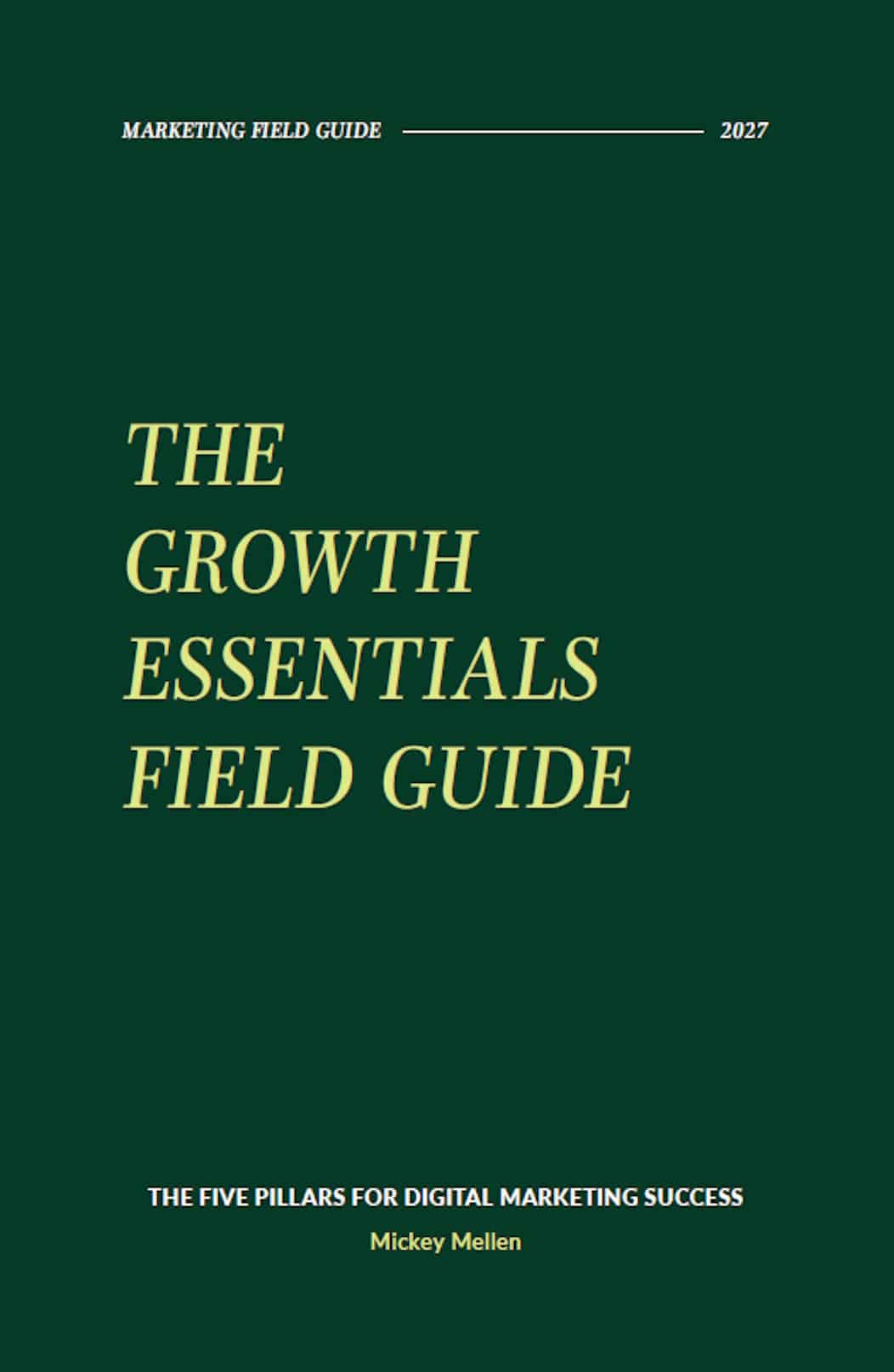
I’ve just published “The Growth Essentials Field Guide”, covering the five core areas that your small business should focus on. Today I’ll be sharing the fourth pillar, which is about your data, including Analytics and CRM systems.
While the book is available on Amazon, just email me and I’ll be happy to send you a copy of the EPUB file for you to load yourself. Better yet, I’ve wired up a special version of Flowstate Reader so you can just click here and read the full book immersively (text + voice) in your browser right now for free.
For you Atlanta folks, I’ll be discussing the book next Wednesday, September 16 at the Northeast Cobb Business association luncheon, so come join us there if you’re free. Here’s pillar four. Enjoy!
Pillar Four: Data
“You’re going to look at lift, not attribution.” – Rand Fishkin
When talking about data, there are a variety of ways we could go. For the purposes of your business, we’re really talking about two things:
Measurement of your marketing, with tools such as Google Analytics and other native measurement tools inside of email marketing and social media platforms.
Tracking of your leads and customers, typically via a CRM (Customer Relationship Management) tool.
Both are essential, and we’ll explain why throughout this chapter.
This isn’t to suggest that we should collect gobs of data on every user who visits your website. As Jodi Daniels shares in “Data Reimagined”:
“Companies that collect consumer data without permission are effectively stealing the currency of intimacy … Happily, the very fact of its difficulty makes treating customers’ data with respect a powerful demonstration of your company’s commitment to them.”
There is also an incessant push to collect and show off ever more data, which often only makes things worse. We’ll explore that as well.
THE MYTHS
“Data tools are far too expensive”
There are big companies that will sell you complex data tools for thousands of dollars a month, but you don’t need that. As shared above, we’re only going after two types of data (marketing and customers) and tools for those are either free or very inexpensive.
For data, tools like Google Analytics and basic social media measurement are completely free. For email marketing, you’ll generally pay a small fee for a tool such as Mailchimp, but all data is included at no extra cost.
For CRM, you’ll likely need to pay a small monthly fee for a solid tool, but tools like Pipedrive start at under $20/mo and can handle everything you need.
“There is too much data, and it’s hard to understand it all”
This isn’t exactly a myth; there is too much data, and it’s indeed hard to understand it all, but it doesn’t have to be. If you have too much data and can’t understand it all, then you just need less data.
The great thing about digital marketing is that it’s so easy to measure everything that you do.
The bad thing about digital marketing is the same thing.
All of the data in the world sounds great in theory, but it can quickly become overwhelming. I’ve seen companies that produce 30-page website data reports every month — they’re really impressive reports, but they’re hard to take action on.
The other challenge is that those 30-page reports are filled with easy-to-find metrics, while much of what you need is the harder-to-put-together pieces.
For example, here are two stats:
- 1,000 people saw your latest Facebook post.
- Of the people who saw your latest Facebook post, 77 clicked through to your website, and 11 bought your product, spending a total of $754.
The first number is super easy to find and marginally helpful, while the second takes more work to set up and track but provides far more insight.
In “Poor Charlie’s Almanack,“ Charlie Munger (Warren Buffett’s former business partner) talks about how to make the best use of data:
“A special version of this man-with-a-hammer syndrome is terrible not only in economics but practically everywhere else, including business. It’s really terrible in business. You’ve got a complex system, and it spews out a lot of wonderful numbers that enable you to measure some factors. But there are other factors that are terribly important, yet there’s no precise numbering you can put to these factors. You know they’re important, but you don’t have the numbers.”
“Well, practically everybody
- overweighs the stuff that can be numbered because it yields to the statistical techniques they’re taught in academia, and
- doesn’t mix in the hard-to-measure stuff that may be more important. That is a mistake I’ve tried all my life to avoid, and I have no regrets for having done that.”
As we work with a client, our goal over time is to reduce the amount of data that we present to them. As we continue to better understand their business, the data we share should become full of those items that are harder to measure but provide much more benefit.
A 30-page report might look impressive, but a single-page summary that hits all of the important metrics is tremendously more valuable.
Over the years at GreenMellen, we’ve worked to reduce the amount of data we share and instead focus on its quality. Rather than a 20-page report, we’ll share perhaps a page or two of data during our review meetings, focused on the most impactful pieces.
In David C. Baker’s book, “Secret Tradecraft of Elite Advisors“, he summarizes it like this:
“You might even look at 40 to 50 data points from time to time, but prioritize them to under a dozen. Overwhelming a client with data can be worse than sharing no data at all.”
The amount of data that we have these days is absolutely amazing, but it can quickly become overwhelming. As a leader, your job is to cull through the data and pull out the gems.
The more unnecessary data you can cut, the better.
THE PROBLEMS
Attribution is getting really hard
Data can be messy, but a growing problem is messy data that looks straightforward. Data will clearly seem to show you something, only to end up being completely misleading. Let me tell you about my friend Jason.
Jason runs a firm called Blumer CPAs, and they’re excellent. We’ve been a client of theirs for many years now, and hope to be for many years to come. How did we initially find them? Here’s the path we took:
- In 2015, we saw Jason Blumer speak at the WordCamp Atlanta conference. I had heard of him, but didn’t know much about him. He did a great job with his talk.
- As a result, I started listening to his podcast and subscribed to his blog.
- He produced solid content on both of those, and at one point had a special offer for a one-hour coaching session, which Ali (my business partner) and I signed up for.
- Not long after that, we decided we needed more help with our finances, and he was easily the first person we thought of.
- So on that day I went to Google, searched for “Jason Blumer CPA”, found his site, filled out the contact form, and became a happy client.
If Jason does a great job with his data, what will it show? It will clearly show that I found him on Google and that’s how we connected. While that’s technically true, you can see that’s not really what happened.
There is literally no way for any tracking system, anywhere, to tell that full story unless Jason had pinned a tracker on me at that conference in 2015 and watched from there. If Jason has a marketing firm that just looks at the data, they will say “Wow, Google brought you a great client, so let’s double down and invest more in Google Ads and Search Engine Optimization.”
This is the problem with “branded” searches, where people search for the specific company that they’re looking for. This is a quickly rising percentage of Google searches, as nearly half of all searches these days are branded. Your data will say they came from Google, but why were they searching for your name in the first place? Was it a great social media post that you wrote? Was it word-of-mouth from their neighbor? Was it because you did a great job at WordCamp Atlanta 2015?
Last touch attribution will lie to you
If you rely on “last touch attribution” (seeing what the user did immediately before they reached out to you), it will often lie to you. In the example with Jason above, our last touch was Google, which was 100% accurate but also 100% misleading.
For example, if someone sees a great video you posted, connects with you on LinkedIn, listens to your podcast, clicks over to a blog on your site, and then contacts you to start an engagement — the blog post receives 100% of the credit for that transaction. This is both understandable and problematic.
As Rand Fishkin shared in a post on his SparkToro blog:
“When people watch videos on YouTube, browse news on the Washington Post, scroll through posts on Threads, dig around Etsy, or trawl through the long tail of the web, they’re exposed to the ideas, information, problems, and brands that turn into search queries.
Can a strategy of building brand awareness, interest, and demand outside of search work? Absolutely.
Just be careful not to ascribe attribution or credit to Google when other investments drove the real value. For most brands, a huge portion of search referrals come from branded search queries, and almost none of those originated on or because of Google. Yet so many marketers throw branded-search-assisted conversions into “sales attributed to Google.”
It may be worth investing in Google, but don’t assume so just because the initial data says so.
Users will lie to you
So the answer must be “ask users how they found you”, and that can indeed be quite helpful. The problem is that users answering that question will very often unintentionally give you bad info.
When you ask users, “How did you find us?” some big problems crop up.
First, the top choices in the “how did you find us?” question will always be the most popular, regardless of the order that you put the options in.
Second, users may associate your brand with a particular source, even if they didn’t find you that way. There was a company in the Midwest that listed a major YouTube channel in the “how did you find us?” options, even though they were completely unaffiliated, and a large percentage of their users chose that (literally impossible) source as their reason.
Your “CRM” is Excel, or worse, your inbox
Another big problem is thinking you don’t need a CRM, or that you’ve solved your CRM needs with an Excel spreadsheet or your inbox.
I’m not suggesting you run out and start using Salesforce, because the only thing worse than not having a CRM is having one and just letting it collect dust. A system that is too powerful for your needs will end up being too complex and remain unused.
Find a simple, stable option and dig in.
We can’t track “it”
I recently saw a popular post on LinkedIn that said, “To kill a great marketing idea in six words or less, just ask ‘how will we track it?’“
Initially, it sounds like a valid thought. If you can’t track it, why do it?
Tracking can be quite important, and we track all that we can, but it can lead to bad decisions. Rather than choosing the direction that is best, we often resort to choosing the direction that is easier to track.
It’s related to the idea of lift vs attribution, which we’ll discuss in a moment. It’s convenient to do only things where you can track attribution all the way through, but you’ll often miss great opportunities if you focus too hard on that.
Track everything you can, for sure, but don’t let that be the deciding factor for your next marketing idea.
THE FRAMEWORK
Treat customer data with respect
The default action for the past few years has been “collect every bit of data you can, and add people to your email list any time you find an address”. This is short-sighted, and in many cases, illegal.
One of the biggest assets many companies have is customer data. By collecting, storing, and using large amounts of data about their customers, they can often turn it into additional profit.
In fact, at this point, it’s almost easier to collect too much data, so those companies that work hard to limit it deserve some respect, as I shared from Jodi Daniels a few pages back.
Less data is more
Not only is it wise to collect less data from both practical and legal standpoints, but it is often all you need. The 20-page report you generate will be largely ignored, but a solid single-page summary with strong data and clear calls to action will go much further.
It’s common for data collection to grow over time. You get new tools or want to see new metrics, and the reports keep getting longer and longer. You should take the opposite approach and work to slowly remove items from those reports.
THE PROOF
Lift versus attribution
As I’ve shared in this chapter, it can be very difficult to track precise attribution. The story of Jason Blumer earlier in this chapter was a great example, but I also heard another story recently that drove this home.
There was a company spending roughly $50k/mo on podcast ads, but their data showed it was driving only 1.8% of conversions, while Google Ads drove 58%. Cutting the podcast spending seemed easy, so they did.
The result? Their cost per acquisition through Google Ads skyrocketed. Why? The podcasts were building awareness and trust, and then people would search for the brand and click the ads. By the time the user clicked the ad, they were already well on their way to being a customer. Without the podcast to warm them up, all of the ad clicks were raw leads and converted at a much lower rate.
Sadly for this company, while it took minutes to cancel the $50k/mo podcast spend, it took them the better part of a year to get it all back up and running as efficiently as before.
Don’t ascribe attribution to Google when other investments drove the real value
As I’ve said, when monitoring your website traffic, it’s easy to look at your sources and see that Google has sent you the most traffic, which can lead you to think you should double down on it. Maybe you should, but maybe not.
There are certainly people that Google sends to your site that you should be thankful for. If someone searches for “plumbers near me” to find your plumbing company, that’s fantastic! However, there are many cases where it may look like Google is sending you traffic, but it’s not really coming from Google.
If your reputation is strong enough that people search for you by name, that is awesome! Really, that should be your main goal. It’s great when people find you for unbranded searches like “plumbers near me”, but if they know to search for you directly, you win.
Google may still find itself in the middle, but you didn’t get that customer via “SEO,” even though they technically came from a Google search. You need to find out how people really discovered you and why they searched for you by name. Double down on that instead.
Tracking down precise attribution can be nearly impossible, but that doesn’t mean you should default to attributing it to Google. Work hard to figure out where your best customers are really coming from, and focus as much effort there as you can.
THE ACTION
There are three simple things you need to be doing when it comes to data.
Don’t ignore this stuff, but don’t overanalyze
First, keep it simple. Don’t ignore your data, for sure, but don’t overanalyze it. I see companies that spend hours poring over their data when that time could have been better spent creating fresh content, attending some in-person events, or myriad other activities beyond playing with spreadsheets.
Work to see where your traffic is coming from and know which pieces of social content perform the best. Just don’t get too wrapped up in every little click.
Get a simple CRM
If you don’t have a CRM yet, get one, but keep it simple. The only thing worse than not having a CRM is having one and just letting it collect dust. While a big fancy Salesforce setup might be effective, if it’s too cumbersome, your team won’t use it, and you’ll be back to essentially lacking a CRM (but paying big dollars for one that’s collecting dust).
Track your pipeline, keep up with your sales process, and stay on top of what the next 6-12 months look like for your company. If the health of your company is only measured by your bank account, you’re in big trouble. A healthy bank account is crucial, of course, but it only tells you how well you’ve done in the past. With a simple and solid CRM setup, you should be able to get a decent glimpse at what the future looks like, so you can take action before it’s too late.
Set up some basic dashboards
The lesson of this chapter is simplicity. If you’re trying to log into Google Analytics to understand what’s going on with your website, you’re gonna have a bad time. There are many tools that can aggregate your data from Analytics (as well as your email and social media tools) into one place. Your marketing company should be able to provide that for you at little to no cost, and if they can’t, you may want to start looking for a new partner.
As with everything in this chapter, you need to find a healthy balance. If your website traffic falls from 10,000 visitors/mo to 800, you need to dig into that right away. However, if you’re concerned because it dropped from 10,000 to 9,867, you have better things to do with your time.
Also, never forget that these dashboards will lie to you. They’ll (hopefully) be giving you pure data, but that pure data can’t tell the entire story. Among other things, the bulk of the traffic from Google was probably routed through Google, but the true source was elsewhere. You can’t usually measure it directly, so save your time (and your money). Keep putting yourself in front of the right people with the right message, and things have a way of working themselves out.
I hope you found this to be helpful. Look for the rest of the book to come out each day this week, but remember that you can just email me and for a free copy of the full EPUB file or you can read the full book on Flowstate Reader here.