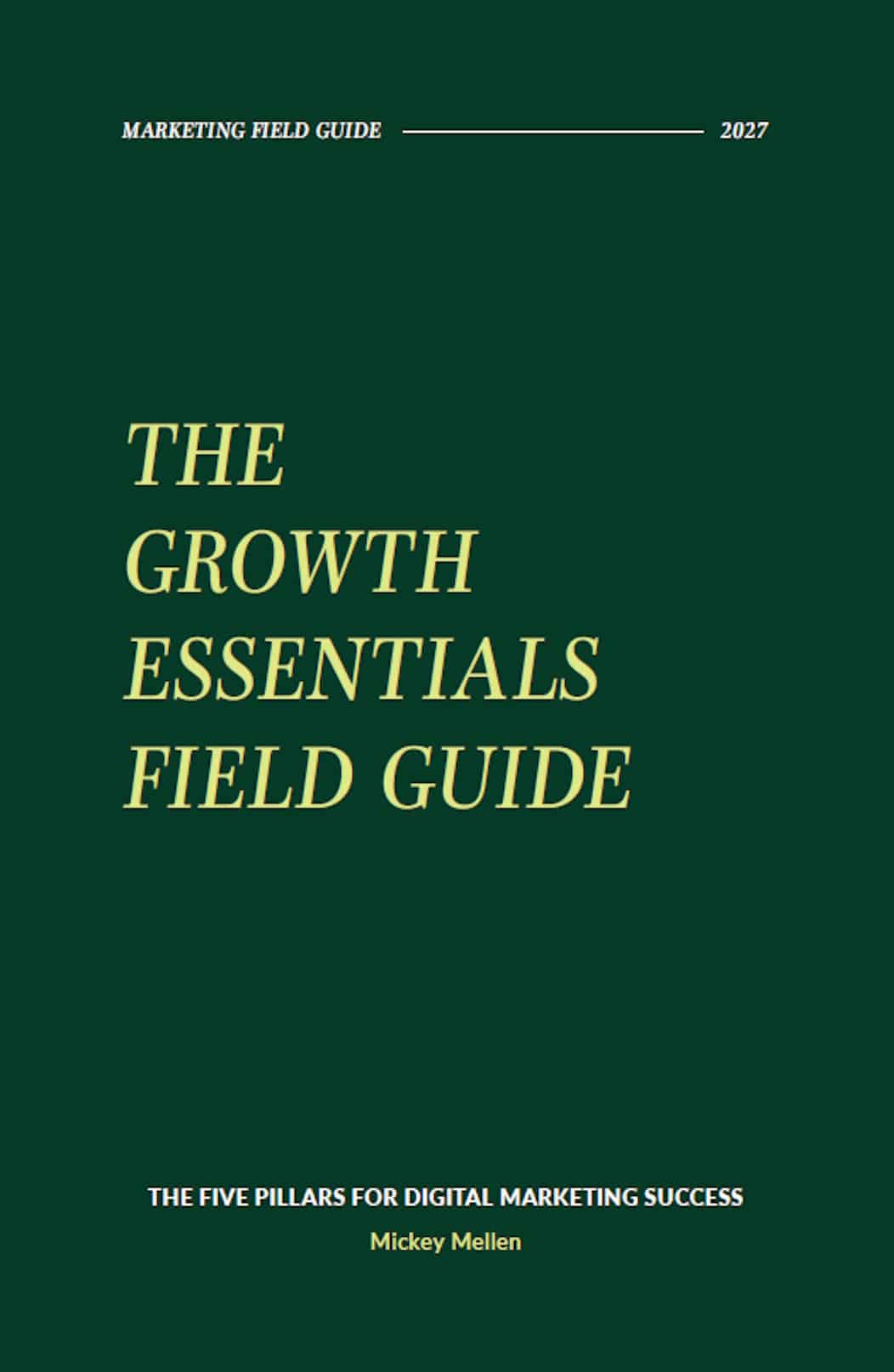
I’ve just published “The Growth Essentials Field Guide”, covering the five core areas that your small business should focus on. Today I’ll be sharing the third pillar, which is about Local SEO.
While the book is available on Amazon, just email me and I’ll be happy to send you a copy of the EPUB file for you to load yourself. Better yet, I’ve wired up a special version of Flowstate Reader so you can just click here and read the full book immersively (text + voice) in your browser right now for free.
For you Atlanta folks, I’ll be discussing the book next Wednesday, September 16 at the Northeast Cobb Business association luncheon, so come join us there if you’re free. Here’s pillar three. Enjoy!
Pillar Three: Local
“Reviews are useful for potential customers when they’re honest and objective. Customers find a mix of positive and negative reviews more trustworthy. You can always respond to a review to show the customers that you care and provide additional context.” – Google
If your business tends to show up when users have “local intent” (meaning that Google thinks they’re looking for someone nearby, whether or not they include a location or “near me” in their search),then ranking well in Google Maps is vitally important.
THE MYTHS
“You need to have five stars”
When looking at the rating for your business on Google or your product on Amazon, what’s the ideal score you should have? Most think that a 5.0 rating is the goal, but it probably shouldn’t be.
When consumers see a perfect 5.0 score on a product or business, they instantly become skeptical. There are cases where a business or product could be a legit 5.0, but according to a study out of Northwestern University, a score between 4.2 and 4.5 is the most trusted.
In fact, many users (myself included) will look specifically for the bad reviews to see what people’s complaints were and how well the business addressed those issues.
From a business perspective, bad reviews can often provide valuable feedback on areas where you can improve.
That’s not to say you should intentionally try to get bad reviews for your company, of course, but having a few 3- and 4-star reviews mixed in with your 5-star reviews is likely more beneficial than you think.
Trust me, I know the feeling of getting a less-than-5.0 review, and it stinks, but at the end of the day, if handled well, it might make your business even more appealing to the next person that comes along.
“I don’t have a physical storefront”
Even without a physical storefront, ranking well locally can be a huge piece of your business. While our agency has a physical office, it’s not intended as a place for prospective clients to drop in. We work hard to rank for local keywords (like “marketing firms in Atlanta”) and find new clients that way.
Local SEO is essential if you have a storefront, but still very important even if you don’t.
THE PROBLEMS
Local is zero sum
As I mentioned in the intro to this book, local SEO is one of those things that is zero sum. If a few of your competitors are in the top map listings, you can’t be. You need to take action to ensure you show up prominently when your prospective customers are searching for you.
Google extracts “near me” from search phrases
It feels like adding the phrase “near me” to your website could be helpful, so that if someone searches for “dentist near me,” your site has a better chance of appearing. Unfortunately, it doesn’t really work that way because Google essentially removes the phrase “near me” from your search, and then just looks for “dentist” in your local area (using “near me” to guide its radius, not as a specific keyword).
For example, if you search for “sushi near me”, Google will run a local search for “sushi”. Whether or not any of those companies have the words “near me” associated with them is of zero value. Instead, it comes back to a traditional search result based on location, rankings, other keywords, etc.
Chris Silver Smith summed it up nicely in a post on the Search Engine Land website:
Google has made it so that a “near me” query will return the closest matching local businesses for one’s search terms within the Maps listings. To do this, Google extracts the “near me” portion of the user’s query and matches the remainder of the query with businesses it believes are closest in location proximity to the user. This handling negates the efficacy of performing keyword optimizations with “near me” phrases for Google Local search.
Putting the words “near me” on your website won’t necessarily hurt you, but it’s of no value, and you’d likely do well to make better use of that space.
Ranking first isn’t always useful
Many people make it a goal to rank first in Google, and it’s not a bad plan. The problem is what you’re trying to rank first for.
This is a common tactic that spammers use — they can promise you a #1 ranking as long as they don’t promise exactly what you’d be ranking #1 for, and that’s the key. If you have a website, you almost certainly already rank first for something, but it may not be what users are actually searching for.
For example, if you search for “weekly previews inefficient“, a post of mine from a few years ago is likely the first one you’ll see. But is that of any value? Probably not, as it’s probably not something that people search for very often. But hey, I’m #1!
It takes some effort to find the right keywords and develop great content to help surface them, but it’s worth it. After all, anyone can rank #1 for something, so make it worth your while to rank #1 for something great.
Citations are tricky and weird, but essential
An oft-overlooked aspect of local SEO is getting many other directories to cite your listing, which lends you more credibility in Google’s eyes. This is not only frequently missed, but kind of weird to resolve. We’ll unpack it more in a few pages.
THE FRAMEWORK
Match local content on your site
Your website should include information about the area you serve and align with what you’re saying on your Google Business Profile. While having dozens of local pages for each city in your area is less helpful than it was in years past, keeping your location references consistent across your website and Google Local listing is essential.
Keep reviews coming in and reply to all of them
Reviews are still the lifeblood of solid local rankings, and you need to keep them rolling in. As I mentioned above, you don’t need a perfect
5.0 rating, but you should certainly strive to be well above 4.0.
Perhaps more importantly, you should reply promptly to every review that someone leaves. Replying to positive reviews is easy and helpful, but replying to negative reviews is where you can really move the needle. By showing empathy and patience with people who had a poor experience with your company, you actually can gain more business as a result. Every company has bad reviews from time to time, and your reaction to those reviews speaks volumes about how you run your company.
Customers buy from brands that they already know
Most customers have some idea of the companies they might want to buy from before they even begin their research, so traditional best practices make sense: provide quality content, answer questions, and serve as a guide as customers research.
In fact, prior to their research, 80-90% of customers already have a short list of vendors in mind, and 90% of those people end up purchasing from one of those vendors! In short, if you’re not in your buyer’s mind before they start their research, you have no chance with more than 75% of your potential customers.
So how do you get into their mind before the research? Spend time in the same places as them online.
Ultimately, you need to be present on podcasts they listen to, on social media sites they frequent, in videos they may want to watch, in blog posts that provide information, and in email newsletters they consume.
The best part about this kind of work is that it’s a win-win-win:
- You show up where they already are.
- You’re providing content and value to help them make the decision ahead.
- AI models like ChatGPT will eat up your content and make it more likely you’ll show up there, too!
So much of marketing these days involves simply staying top of mind. When a customer is making a list of vendors like you to consider, make sure you’re already one that they’ve thought of before, or else you’ll never even have a chance.
THE PROOF
Slow and steady wins the race
We were recently working with a client that had a handful of massage studios in the area. Before working with us, they had issues with their Google Business Profile, so they created another account. They had issues again, so they created a third. It became a big mess.
Each time, they were understandably anxious to get things fixed, and each time they made things worse. We had to insist that they slow down, take a breath, and then work through them slowly. Over the following weeks, we merged the other two locations into their main location, preserved all their reviews, and now they’re humming along again.
Google can do some very frustrating and confusing things with local business profiles (often suspending them for no apparent reason), but being reactionary will only make things worse.
Use your local advantage
Last year, we wanted to refinance our house, so we found a local broker that came recommended, and he did a nice job. There are literally thousands of seemingly identical brokers we could have used, but we went with a local company so we could work with someone we knew and trusted.
A few months later, “he” called my cell phone, but it turned out to be an AI bot he had purchased that called all of his clients to see if they wanted to refinance again.
This was a huge mistake on his part.
He undoubtedly got suckered in by a company promising to have AI “bring in tons of business”, but he forgot who he served. In a business like his, relationships are everything, and that random AI in between him and us was super weird.
This doesn’t apply to all businesses, but for most small businesses, your local presence is incredibly valuable. Lean into it, be human, and avoid shortcuts that put you further away from the people that you love to serve.
There can be huge gains if your citations are weak
I mentioned local citations a few pages back, and you can find huge gains if your citations are weak and you bring them up to speed.
These “citations” are simply your business listings on other directories, such as Yelp, Yellow Pages, Apple Maps, Foursquare, and dozens more. You are unlikely to get much traffic directly from any of these, but your listings on those directories give you more credibility in the eyes of Google and can help you rank better with them.
When building those citations, just remember your NAP – Name, Address, Phone:
- Name: Your business name should be identical everywhere. Are we “Green Mellen Media, LLC” (our legal name), “Green Mellen Media” (remove the LLC), or “GreenMellen” (what we usually go by)? None are better than the others, but consistency is key.
- Address: Same goes for your business address. Are you “123 Main Street” or “123 Main St NE”? Are you in “Suite 200” or “# 200”? Again, there is no wrong way to do it, but you need to be precise with every listing.
- Phone: Lastly, make sure your phone number is identical across all of those listings. This is often the easiest for companies to be consistent with, but just be aware that it matters.
Ok, so how do I “build citations”? Fortunately, it’s pretty easy.
If you’re working with a marketing agency, they likely have already purchased a tool that can help you with that and can help update those (and keep them updated) for a low monthly cost. If you aren’t working with a company for that kind of thing, there are plenty of tools you can use.
THE ACTION
You should have a pretty clear idea of some simple next steps, but let’s walk through them.
Reply to every review
As mentioned above, reply to every review that comes in. Personally, as a customer, I try to find some of the non-5-star reviews, see what the issue was, and then see how the business responded. Heartfelt responses from a business can mean a lot, and if you combine that with a ~4.5 kind of average, things should work out pretty well for you.
This is backed by Chris Malone in his book “The Human Brand”, where he says that “people want to see your replies to bad reviews”. Perceived warmth and competence can drive loyalty.
Make sure your website keeps current
While you’re working hard on your Google Business Profile, make sure your website stays up to date as well. Continue to post content on your site that reflects your work in the local area and supports what’s happening on your local profile.
Get those citations tightened up
Your local citations might already be in decent shape, but if you’ve never done any specific work to improve them, they’re unlikely to be. This is a pretty easy fix, and it’s mostly hands-off (your agency or the tool you purchase will do the bulk of the work), and it can make a big difference for a lot of companies.
I hope you found this to be helpful. Look for the rest of the book to come out each day this week, but remember that you can just email me and for a free copy of the full EPUB file or you can read the full book on Flowstate Reader here.