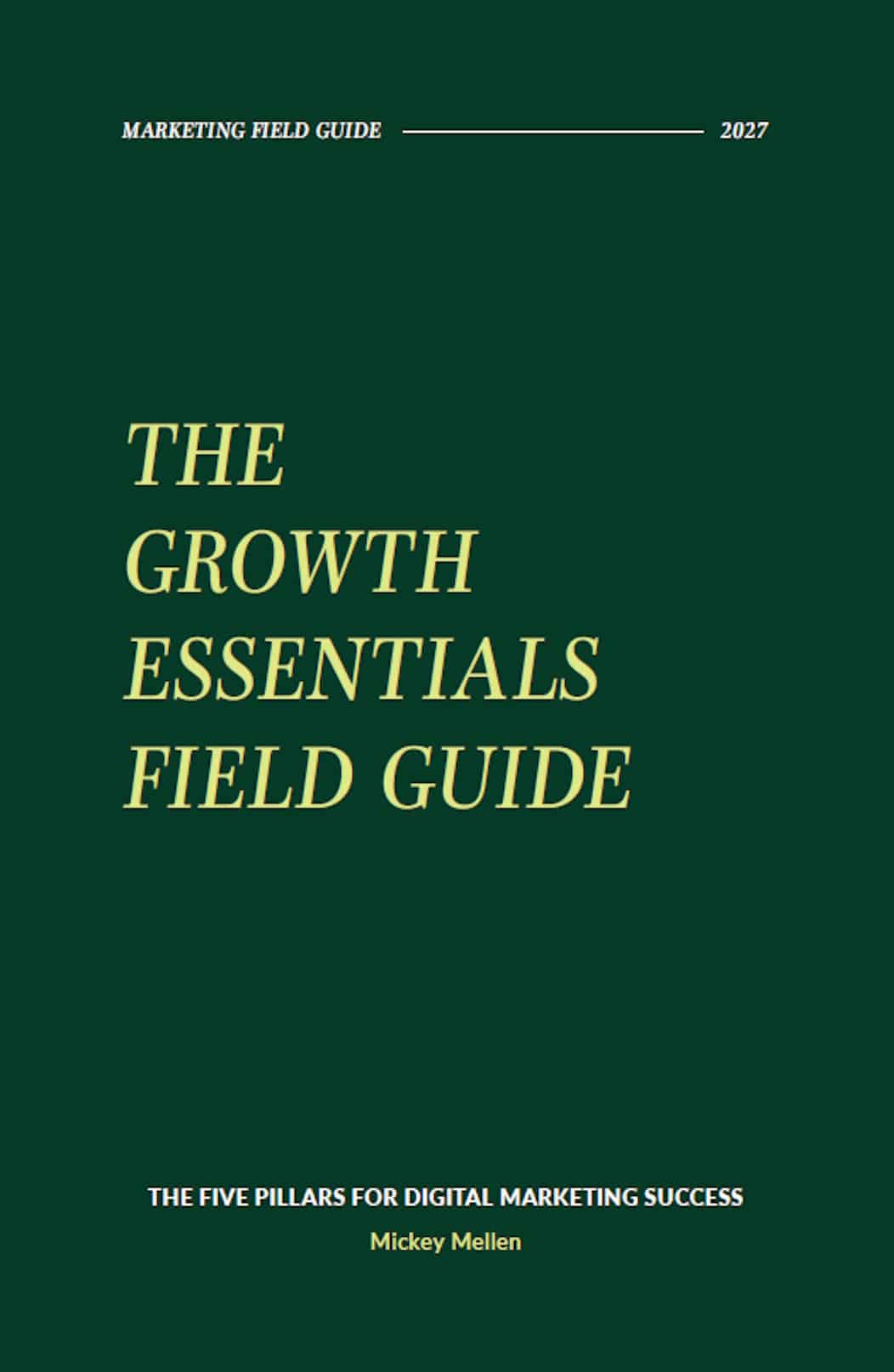
I’ve just published “The Growth Essentials Field Guide”, covering the five core areas that your small business should focus on. Today I’ll be sharing the second pillar, which is about email marketing.
While the book is available on Amazon, just email me and I’ll be happy to send you a copy of the EPUB file for you to load yourself. Better yet, I’ve wired up a special version of Flowstate Reader so you can just click here and read the full book immersively (text + voice) in your browser right now for free.
For you Atlanta folks, I’ll be discussing the book next Wednesday, September 16 at the Northeast Cobb Business association luncheon, so come join us there if you’re free. Here’s pillar two. Enjoy!
Pillar Two: Email
“I’d rather have 1 new email subscriber than 1,000 more followers on Facebook.” – Rand Fishkin
I mentioned that websites are one of the few assets that you can own, and email is the other big one. While you can’t take your Instagram followers with you to a new social platform, your email list is yours to own and control.
Ultimately, email marketing is a huge opportunity that’s oft-ignored. This chapter will largely focus on email marketing to your lists, but will also touch on tips for better one-to-one email.
THE MYTHS
“No one reads email anymore”
Every few years we hear that “email is finally dead”. It’s not.
Social media, SEO, and digital ads can be great ways to help promote your business, but lowly email still generally has (by far) the best return on investment. According to a recent study from some top companies, via PC Mag:
The study showed that email-marketing ROI is currently calculated to be 4,400%, or about $44 return on every dollar you spend in your marketing campaign.
There are two big reasons why email is still huge, and why it’s not likely to go away any time soon:
- Everyone has it. Some people check it more often than others, but no one can escape it. By comparison, your friends, colleagues, and customers are spread around various social networks, with things fragmenting a bit more every day. In some ways I still wish that “everyone” was on Facebook, but they’re not, and they’re not all going to come back.
- It’s an open protocol. If you don’t like Facebook and you leave for Parler, you can no longer talk to people on Facebook. If you don’t like Gmail and leave for Proton-Mail, you can still email 100% of the people you could before. Yeah, changing your address is a bit of a pain, but you’re not cut off from anyone. The core tenets of email make sure that’s possible.
Email has challenges, for sure, but I don’t see either of the above advantages changing anytime soon. Email is often a challenge due to user laziness (“it’s just easier to create a Facebook group”), but as social media continues to slowly splinter into separate apps, email will likely remain the one place that you can reach everyone.
“Social media is a better way to reach people”
While I have my share of bad things to say about social media, I’m still fairly active on most networks and plan to be for the foreseeable future. I suspect some of you found this guide via social media, and that’s great!
In the long run, though, email is where your followers need to be. Not that email is great, per se, but you can truly own your list, and that is hugely valuable. David Perell calls this taking your users over the “Public to Private bridge”.
Perell’s idea is that you should build a bridge to bring users to your private channels, slowly guiding interested users onto your email list and other private channels for sustained growth.
Rand Fishkin recently laid this out in a post on the state of the web and what creators need to do. In that post, he included the thought:
“I’d rather have 1 new email subscriber than 1,000 more followers on Facebook”
It’s amazing to me that email remains one of the best ways to reach people, but the numbers don’t lie. Continue using social media to the extent you desire, but do your best to keep growing your list.
“The only way to build an email list is through shady tactics”
You’ve likely seen it 100 times. “To get this free PDF with 10 tips to prepare for winter, give us your email address and we’ll send it right over“. It’s been a solid way to grow email lists for years, but it brings along one old problem and one new one.
In many cases, the people who sign up for your list aren’t likely to become customers. If you own a local company that designs and installs pools, a popular giveaway might be something like “The best ways to prevent algae from growing in your pool”. It’s helpful, and might be quite popular!
The problem is that the people who need that document already own a pool and seem to manage it themselves (and they could be located anywhere in the world). The benefit is small.
In addition, the email gate turns many people away. They might be interested in your content, but they aren’t willing to give up their email address for it. Instead, you should just brand it well and give it away. It’ll spread much further, and it’s more likely to end up in the hands of a potential customer. That’s what we do with our downloads, for things like storytelling tips, marketing checklists, social media best practices, and more. We feel that they’re quite helpful, and you can just click and download them without giving us any information.
Over the last few years, a new problem has developed: AI. Generally speaking, if you want to show up in AI-powered search results, you need to feed the systems a ton of content. If you have great documents and info hidden behind an email gate, AI tools will never see them.
Ranking well in AI is tricky and always evolving, but hiding your content is a sure way to hurt your potential.
The internet is moving faster, and people are more reluctant to give up their personal information. If you have great things to share, share them; the benefit of spreading your knowledge will far outweigh the handful of email addresses you might otherwise earn.
THE PROBLEMS
Spam makes it harder for the good stuff to shine
A few years ago, I used a video tool to send a few quick videos to the members of my membership committee for the Kennesaw Business Association. I spent some time creating 20 unique 30-second videos for each person on the committee, checking in on how they were doing and letting them know about our next meeting.
Of the 20 that I sent, three watched the video, and just one replied. That was it! I think people are so used to being hit with “email blasts” that it’s hard for a personal message like that to come through. While I think the video concept is great, I just have a hard time getting people to open them; even those that I know personally that have specifically asked me to reach out!
Online trust is fading. We shouldn’t hustle people that we want to serve, but it can be hard to stand out among the hustlers. Regardless, I encourage you to stay strong and do the right thing, and the people that watch what you do will see the ways that you stand out.
Cold outreach is a form of the tragedy of the commons
The tragedy of the commons is the concept that if many people enjoy unfettered access to a finite, valuable resource, they will tend to over-use it and may end up destroying its value altogether. This is generally applied to things like farmland, but I think it can also apply to the internet, with the “finite, valuable resource” being our attention.
If everyone behaves properly, the resource stays useful for all. If a few people misbehave to take “just a bit more” for themselves, it can encourage everyone to try to take a bit more and destroy the value for everyone.
This is cold outreach in a nutshell. We have an amazing tool with the internet, but as more people try shady things to steal a bit of attention, it encourages others to do the same to keep up. As I’ve shared from Seth Godin a few times:
“People are smart enough to see that once spam becomes professionally and socially acceptable, all open systems fall apart.“
Techniques like cold calls and spam are tempting, for sure. The cost is essentially zero, and you can potentially make 10 more sales if you just bug 24,990 other people in the meantime.
The internet is unbelievably massive, but the attention of humans is a scarce resource and should be respected by everyone, or we risk ruining the entire system.
Experts don’t cold call
If you want to be seen as an expert, cold calling will destroy that idea. Some of the funniest emails I get are from “SEO experts”, and I’m sure you get many of the same. My initial thought is “if they’re so good at SEO, why do they need to resort to spam?”
Of course, they’re not any good at it, which is why spam becomes their tactic.
In a classic post from Seth Godin over a decade ago, he defines spam this way, and explains the wider repercussions if we agree to allow it as an acceptable way to do business:
Spam is commercial, unsolicited, unanticipated, irrelevant messaging, sent in bulk. It’s the email you didn’t ask to get, the junk in the comments that’s selfish and trying to sell something, the robocall on your cell phone from a company pretending to be Google Maps.
Some spammers will tell you that all you need to do is opt out. But of course, the very problem with spam is that it requires action on the part of the recipient, action that can’t possibly scale (how many times a day should we have to opt out, communicating with businesses we never asked to hear from in the first place?) People are smart enough to see that once spam becomes professionally and socially acceptable, all open systems fall apart.
A recent episode of the excellent 2Bobs podcast (a fantastic show from Blair Enns and David C. Baker) brought this around again with a slightly different angle. From David:
“I’m also just struck by something else you said about how other experts in your life show up. I’m just laughing as like, so who is the expert in your life? Maybe it’s a divorce attorney, or maybe it’s a medical practitioner, an expert, or maybe it’s somebody that’s trying to get you out of a tax issue or something, did any of these people call you ahead of time and ask for your business?”
Experts don’t spam you. They don’t send cold emails or call your cell phone to try to win your business. When you need an expert, you know how to find them. If they’ve done a good job, they’re already in your sphere to some degree, making it an easy decision for you to reach out when you need them.
Related to David’s comment, I’ve never needed a divorce attorney, a medical expert, or help with a tax issue, but I already know the first person I’d call for each of those scenarios. None of them have ever spammed me, but they’ve positioned themselves as experts in their field so that when the time comes, I know who to call.
David’s podcast partner on the “2Bobs” show, Blair Enns, makes it very simple:
“David and I effectively agree that cold outreach is the domain of spammers.”
If an “expert” reaches out cold, you should quickly question whether they’re an expert at all.
THE FRAMEWORK
Short emails are a good thing
There may be rare circumstances where a flowery email is appropriate, but 99% of the time you’re better off just getting to the point. Thanks to AI, many people are writing a short email and then using AI to unnecessarily expand it to make it more “professional”.
The end result is wasted effort on both sides, and likely a degree of miscommunication. It’s kind of like using Google Translate to translate text from English to German, then back again. It’s likely going to have the same overall sentiment, but some things may get lost in translation.
Don’t be curt with your colleagues, but don’t feel the need to make emails unnecessarily long. Share what you need and move on.
We’re seeing similar trends with email marketing. It used to be that a “proper” email newsletter covered a wide variety of topics, shared blog posts and social media content, and tried to be almost like a monthly magazine. These days, you’ll find far more success with a succinct email that conveys a single message.
The book Smart Brevity suggests simply using “one topic per email; no one is reading your 57 news stories.”
Short emails can be great.
Who are your emails from?
When you’re working on a big email marketing campaign, most of the focus is on the content of the email itself — as it should be. Next is the subject line, which is a big factor in open rates. What’s often overlooked, though, is the name and address that your email is “from”.
While I generally think of the subject line as the most important element for getting people to open an email, the folks at Campaign Monitor have said that “studies on email open rates have found that trusting the sender is the single most important factor in whether an email is opened or not.” If the “from” field is suspicious, nothing else matters because the email will never be opened.
There’s no single right answer about what to use. There are two general directions you can go: the name of the company or the name of a human. In most cases, the human name will perform better.
Of that, though, you have a variety of choices for people to use:
- The company founder
- The marketing director
- The customer service rep that many clients know
Finding the right person is up to you, and it may take some time. If you’re not sure, run some A/B testing with different “from” names to see which performs best.
Campaign Monitor says that “trusting the sender is the single most important factor in whether an email is opened or not.”
As long as you use a real person (and never ever use “noreply”), you should have favorable results.
THE PROOF
There are bad ways to handle your email marketing
I know you see many horrible examples of email marketing in your inbox every day, so the main lesson is to simply avoid behaving as those companies do.
A few years back, I was on our local Subaru dealer’s website and had to enter my email address to get a quote. I did; they provided the quote, and we went our separate ways. However, they also added me to their newsletter list (which I wasn’t told about and certainly didn’t opt in to), and they sent everything from a “noreply” address because they really weren’t interested in a conversation. That turned a previously enjoyable conversation with them into a way of thinking about them in an entirely different light.
The same just happened to me at a local restaurant. I did the “QR code to pay” thing, which is fine, but they took my info from that and added me to their mailing list.
The “add emails to our list at all costs” is becoming an epidemic, but there are signs that it may begin to slow.
Done well, it can work quickly
If you’ve properly built a large and relevant list, using it appropriately can produce amazing results. We worked with a local HVAC company a few years back that had a solid history but hadn’t done anything with email in quite a long time. We took their existing list, cleaned it up, and sent out a short message to their previous customers. That one little email brought in $50k worth of business almost immediately.
THE ACTION
The main action you should take is pretty simple: dust off your list and send out pure value to people who are already expecting to hear from you.
Focus on a single topic
When you send an email, choose one topic and dig into it. You may have seven things you want to share, and they might all be important to you, but if you send seven topics in an email, most people will read zero of them.
Pick the one that will be the most valuable for your audience and roll with it.
Be careful who they’re “from”
When we send an email out to our list at GreenMellen, you can click reply, and it’ll come directly to me. If I’m going to ask you to read an email from us, I should be willing to read one from you. The fact that most companies intentionally avoid this is baffling to me.
I want to hear back from people on our list, and you should too.
Be consistent
Ultimately, just be consistent. You don’t need to send emails to your clients constantly, but waiting a year between messages isn’t good either. Shoot for something consistent but not overwhelming, like perhaps once or twice a month.
As Seth Godin has said, “persistent, consistent, and frequent stories, delivered to an aligned audience, will earn attention, trust, and action.”
I hope you found this to be helpful. Look for the rest of the book to come out each day this week, but remember that you can just email me and for a free copy of the full EPUB file or you can read the full book on Flowstate Reader here.