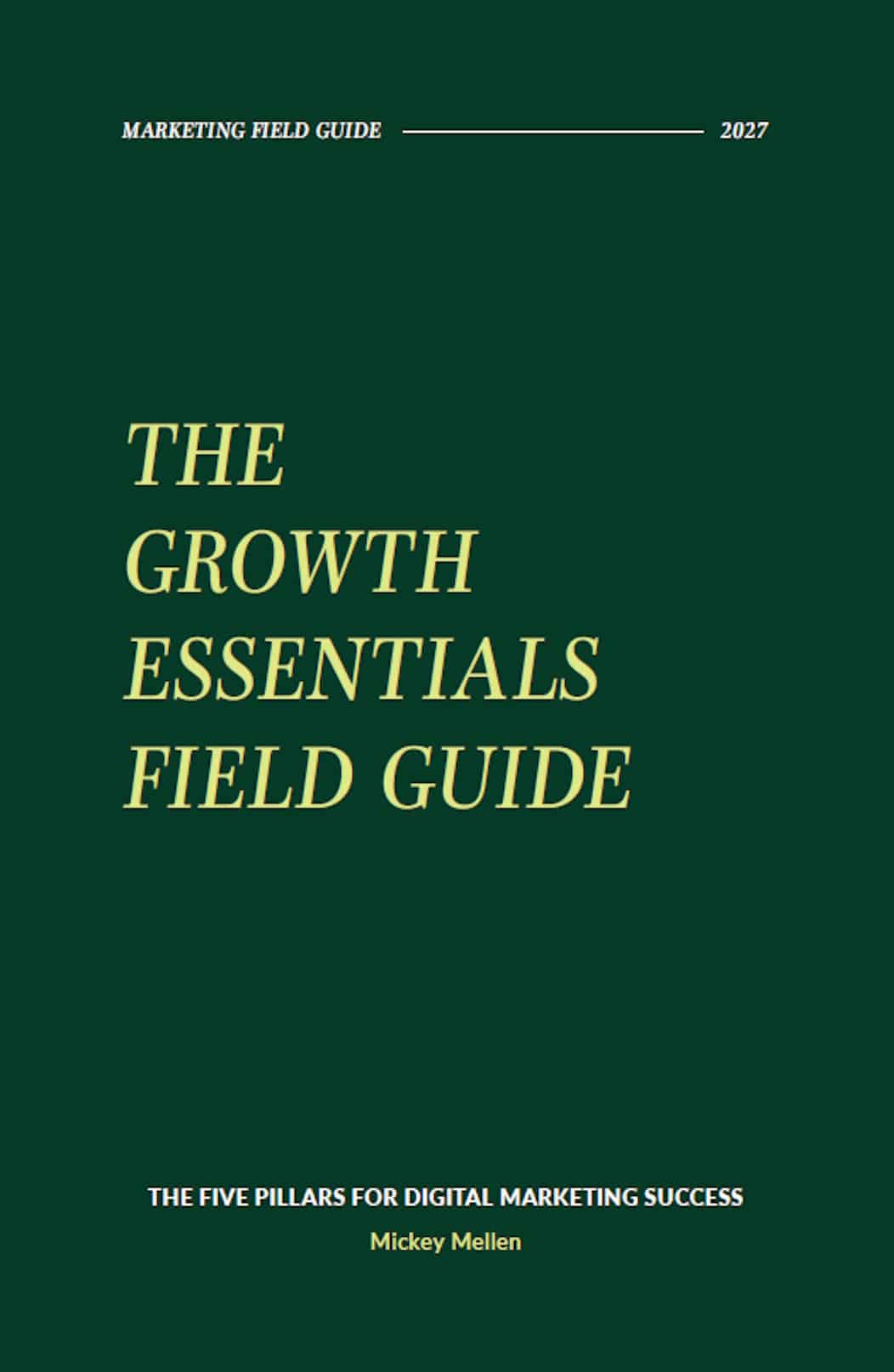
I’ve just published “The Growth Essentials Field Guide”, covering the five core areas that your small business should focus on. Today I’ll be sharing the first pillar, which is about your website.
While the book is available on Amazon, just email me and I’ll be happy to send you a copy of the EPUB file for you to load yourself. Better yet, I’ve wired up a special version of Flowstate Reader so you can just click here and read the full book immersively (text + voice) in your browser right now for free.
For you Atlanta folks, I’ll be discussing the book next Wednesday, September 16 at the Northeast Cobb Business association luncheon, so come join us there if you’re free. Here’s the intro and pillar one. Enjoy!
The world of marketing is changing, but not nearly as quickly as you’re led to believe. We’ve constantly heard about how “Google keeps changing the rules.” They never did (until AI burst forward, which we’ll discuss soon), and every update from Google was simply a greater effort on their part to enforce the rules they already laid out. Here were Google’s official quality guidelines from 2002:
- Make pages for users, not for search engines.
- Avoid tricks intended to improve search engine rankings.
- Don’t participate in link schemes designed to increase your site’s ranking or PageRank.
That’s it! Literally everything Google did was in service to those goals. People who felt the rules were changing were simply trying to cheat the system and were upset that Google had caught on.
In 2023, Google’s Danny Sullivan tweeted:
“Our good advice then remains the same over two decades later. To succeed in Google Search, focus on people-first content.“
There is certainly more that you can do beyond those three items, but those three things will take you 90% of the way there. Sure, you should do lots of technical things like installing Google Analytics, setting up XML sitemaps, customizing your meta descriptions, organizing your topics, and a bunch of other things. Those will indeed help a bit, but everything beyond those core three ideas will only do 10% of the work.
Making great content that helps people solve a problem is key. As Seth Godin said in “This is Marketing”:
“Marketing is the generous act of helping someone solve a problem. Their problem.”
If you can solve someone’s problem and they’re aware you can, you win.
ZERO-SUM
Search was, and still is, a zero-sum game. With that, I mean that when a new Google update came out where it seemed that “every website dropped in the rankings”, that simply couldn’t be true. If one company was losing rankings, that literally means that others gained rankings. By working hard and following the rules, we saw every “horrible” update inch our clients a bit higher toward the top.
The search engine game has changed significantly since ChatGPT came out in 2022, but the core fundamentals of marketing remain the same. You need people to see what you do, understand how it can help them, and know how to move forward with you. That’s it.
Over time, the percentage of users on Google searching for a specific company (“Acme”) rather than a specific solution (“Companies that sell anvils”) has skyrocketed. I heard tech CEO Rand Fishkin say that “Google has become the reward for getting marketing right in all of the other channels rather than the place to start.”
Users find you on Google because they’re already looking for you. Why would they already be looking for you? That’s what this book is about, and why the digital marketing agency I co-founded has set up a system to help you attain it.
ARTIFICIAL INTELLIGENCE
Now we’re firmly in the world of AI, and that seems to be all that people talk about. It’s for good reason, as AI is going to dramatically shift how we live and work, but it’s causing too many businesses to ignore the fundamentals.
Don’t ignore AI, and we’ll touch on it a bit in this book, but let’s stop chasing trends and instead double down on the basics.
When it comes to marketing, you have two broad areas to focus on: strategies and tactics. Strategies are wildly important, but AI is merely a tactic. Don’t ignore it, but don’t lean too far into it.
Strategy always comes first, so AI should always come second. If you flip that around, you’re gonna have a tough time.
Keep in mind that Google isn’t dumb, nor are any of the other AI platforms. They can see and understand what you’re writing, and they get better at it every single day. If you’re producing great content and getting mentioned by other websites and users, they’ll see that. Tagging and schema and things of that nature can help a little, but Google doesn’t need your help.
They already see you. Focus on what matters, and your marketing will soar. Here are the steps to do just that.
THE FIVE PILLARS
For small businesses, there are simply five core things you need to focus on, which we’ll call the five pillars. These are intended to help hold your marketing together and give your business the structural integrity that it needs. Together, they form an acronym: WELDS:
- Website. Without a solid website, marketing can lead to dead ends.
- Email Marketing. Email remains one of the highest ROI activities for a business.
- Local. If people are searching locally, you need to show up.
- Data. Do you know who came to your site? How they got there? Determining next steps is impossible without solid data.
- Social. Social media can’t be ignored. You don’t have to be an influencer on TikTok, but you need to have a presence.
None of these need to be big lifts. While you can spend $50,000 and get a killer website, or post on social media 15 times a day and see results, most businesses just need to do a fraction of that. Consistency beats volume every time.
Seth Godin says in “This is Marketing” that “persistent, consistent, and frequent stories, delivered to an aligned audience, will earn attention, trust, and action.”
Just like welding, this is all about structural integrity. If you don’t have strong connections, your marketing will fall apart. If you get all of the pieces together, it becomes an amazing machine.
Marketing is everything you do, and the WELDS system provides the foundation to make it happen. It doesn’t cover everything, but it will take care of the 80% of the pieces that are the most impactful. Outside of WELDS, marketing is also:
• How you answer the phone.
• How you show up to serve your customers.
• How you treat your vendors.
• How you help your community.
It’s similar to branding, which I see as this simple question: when people hear about your company, what do they immediately think of? That’s your brand.
Good marketing is often boring, and that’s not a bad thing. A Super Bowl ad would be fun to run, but very few companies ever get that chance. Instead of pressing toward that unreachable level, lean into the opposite. Push for reliability over novelty, systems over stunts, and trust over tactics.
This will lead to marketing that may seem somewhat boring, but is much more effective.
We’ll dig into all five areas, walking through a few simple ideas for each.
1. The Myths: What kind of unnecessary beliefs do you have in this area?
2. The Problems: What problems do small businesses most commonly make here?
3. The Framework: What is the overall strategy to solve this problem?
4. The Proof: What are some stories and examples about how this went wrong and got corrected?
5. The Actions: What are things I can do today to get things moving in the right direction?
—
Pillar One: Website
“The launch of a website isn’t the important part — it’s the tending that matters.”
While the power of websites has dropped in recent years due to changes with AI and search, it’s still an essential part of your business and one of the few assets you can actually own (you’ll never “own” your Facebook page). When your marketing is going well, people come to your website, and it needs to keep showing them how you can solve their problems.
In the end, solving problems is all that matters. People have something that needs to be resolved, and you have the solution for those people. Keep that as your focus through all of your marketing.
In Donald Miller’s book “Marketing Made Simple”, he explains that “your customers are not curious about you, they are curious about how you can solve their problem.”
Seth Godin shares something similar in “This is Marketing”, explaining that “marketing is the generous act of helping someone solve a problem. Their problem.”
Lastly, don’t overdo it. People are busy. Get to the point. In the book “Smart Brevity”, they explain that “People are overwhelmed with information, yet most communication is unnecessarily long, unclear, and ineffective.”
THE MYTHS
There are a few myths surrounding websites; some brand new, and some as old as the web itself.
“I can just pick a template.”
Yes, you can, but why? Having a clean, good-looking website is important, but your content always comes first. We recently had a client who paid a lot of money to a firm to design their website, and then they went in to try to write content to fit the design. The design looked great, but it became a disaster because they had to make their content worse in order to fit.
“I don’t have time to build a new website.”
I have good news and bad news for you on this one: you might not need a new site; you might just need to get to work on the one you already have.
I’ve talked to a variety of people who were looking to build a new site because “our team page is no longer accurate, and we haven’t published a news story in 23 months”. Cool, no need for a new site; let’s just update that team page and publish some news.
When companies build a new website to solve problems caused by negligence, those problems start festering again almost immediately.
“My website is finished.”
Related to the previous myth, it’s dangerous to think that your website is ever done. As soon as you do, you become that company with the messy team page and the lack of news. Think of your website more like a garden and less like a billboard:
- A billboard is a static thing that you put up and hope that works. A garden is dynamic and grows and evolves over time.
- A billboard is a one-time project. A garden is a living asset that grows more valuable over time.
- A billboard either works or it doesn’t. A garden continues to grow, and small improvements can lead to big outcomes over time.
“I have social media, so I don’t need a website.”
Having a website is still essential for any business. We’ll talk about ownership later in the book, but a website is one of the few tools in your digital arsenal that you actually own. You may have an awesome following on a particular social media platform, and that’s fantastic, but it can disappear overnight (you could get banned, the company gets bought, trends shift). Your website is yours, and you need to build that solid ground as much as possible.
THE PROBLEMS
We’ve all seen websites that are wildly problematic, but there are some smaller things that you may not notice.
Too self-centered
It’s so easy to be accidentally self-centered on your website. I mean, it’s about you! That’s not why people visit, though. People are coming to your site with a problem, and they need to quickly determine whether you’re capable of solving it.
If your website leads with “help us celebrate our 20th anniversary”, you’ve missed the mark. The person that just came to your website needs help, and the fact that you’re celebrating your 20th anniversary doesn’t help them at all.
There is a bit of an exception to this, though. Once they understand that you’re the kind of company that might be able to help them, they’ll often want to know more about you (via your “about” page, blog posts, and related media). If you lead with “celebrate our 20th anniversary,” and your competitor leads with “here is how we can solve your problem”, you just lost.
Unclear
Donald Miller’s StoryBrand framework offers a quick test to determine whether your site is clear, which he calls “the grunt test”.
In short, users should be able to answer these three questions right away:
- What do you offer?
- How will it make my life better?
- What do I need to do to buy it?
That’s it. Get that info taken care of, and if the user likes what they see, then they’ll dig in for more. Save your “20th anniversary” and your “commitment to be #1” for later, and make sure people know exactly how you can help them after their initial grunt.
Too chaotic
When building a website, it’s a common desire to want to make it flashy. Add more animations! Attract attention!
Of course, when someone is already on your site, what are you trying to “attract”? At this point, they simply need to know whether you can solve their problem, and flashiness and animations are unlikely to help with that.
If you want to add animations to your site, they should serve one of three goals:
- Impact: Make people feel the power of what you do, like a beautiful drone flyover at the top of the page.
- Focus: Movement on the page that draws the eye where you want it to go.
- Interaction: Movement to let the user know their action was correct, such as a button changing color after you click it.
Beyond that, it’s just noise. Being clever and distinct sounds good, but it’s often a bad idea. As shared by Blake Howard in his book “Radically Relevant”, “it’s a mistake to sacrifice clarity on the altar of distinction“.
Keep your site calm and focused on the problem you solve. With less chaos, your message becomes clearer, and that’s the best path to success for everyone.
Devoid of humanity
It seems like the internet is getting louder every day.
More social media.
More AI.
More spam.
More videos.
More more more!
The web is being flooded with over-optimized websites and funnels, and humanity is seemingly disappearing.
That’s unlikely to reverse course anytime soon, but you can. If you can offer some clarity and restraint, that can signal confidence to those who find you.
Make things clear, simple, and human-focused, and then consistently do the little things to stay on that path. You can try to run faster and faster and faster, or you can take steps to escape the madness and be a human who likes working with other humans.
Valueless
I’ve heard Google’s John Mueller encourage people to “ask yourself why would anyone go to this site instead of the thousands of others.” It’s similar to the classic known as the “Deb Oler question”, which poses: “why should our customers buy from us over anyone else?”
You certainly need to work on your page speed and other technical items, because if those are a mess, it’s a problem. Once you reach a certain point, though, it becomes a case of diminishing returns. Instead of trying to make your site load 2% faster, spend some time producing great content that your users will love.
Ignored
As we mentioned above, with an inaccurate team and a lack of news, there are many ways a site can be neglected.
“Set it and forget it” is the dream solution to many challenges in life, but it rarely works. 25 years ago you could build a website and largely leave it alone, but those days are long gone. When you let your website just sit there, bad things can happen.
- Contact forms stop working, and you have no idea.
- Visitors may see security warnings that you’re unaware of.
- The content on your website is so outdated that it undermines credibility.
- You have tons of data about the visitors on your site, but you never look at it (much less act on it).
- Your site can get hacked, and most hacks are things you’ll never notice on the front of the site (like sneaky links to casinos in the back end that Google will penalize you for).
Fixing this stuff isn’t necessarily complicated or expensive, but it takes work. Someone needs to be watching, noticing, explaining, and planning. That someone could be you, but if you don’t have time, then it could very well be someone like us (or one of the other great website firms in your area).
You have many options to help keep things running smoothly, and you should take advantage of them, because if you try to “set it and forget it,” you’re likely to encounter major problems you won’t notice until it’s too late.
THE FRAMEWORK
Have a goal for every page
One of the biggest things that companies miss on their website is goal setting. Not from a high-level, necessarily, but from the level of each individual page. Every page on your site should have a goal.
The goal doesn’t have to be a huge achievement; it could be as simple as helping users understand one feature of your product, with a call to action at the end to learn the next piece. Really, simply having that call-to-action is the key to your goal on many pages.
There are too many sites that have great information, but then leave users hanging at the end of the page without a clear next step. While some users will take the initiative to find out more, it’s always wise to give a clear option for those that aren’t sure.
Don’t just own your website; care for it
As I mentioned a few pages back, one of the biggest shortcomings of websites is when they’re simply left alone.
This doesn’t require a huge effort. I’m not talking about hours a day, but just a bit of focused effort (which you can do yourself, or hire it out). Things like:
- Managing security patches to avoid hacks and downtime.
- Updating your blog with information that your customers would find valuable.
- Updating other areas of your site with new processes, products, staff, and ideas.
This isn’t difficult, but it doesn’t happen automatically, and if you don’t carve out intentional time to make it happen, it literally never will. A few minutes a week is all it takes, and I encourage you to start right now.
What happens between website redesigns matters
When you’re building a new website, launch day is super exciting — as it should be! There’s been a ton of work that’s gone into the new site, and it should be celebrated.
At our agency, GreenMellen, we certainly do this. When we launch a new site, we celebrate with the client, post about it on social media, and feel good for a job well done. However, very few other people outside of our two companies really care about that moment.
Why should they? They’re likely happy for you that you got the new site launched, but it doesn’t really affect them.
Websites need a good overhaul every so often (3-5 years in most cases), but it’s the work that happens between launches that really makes the difference.
Measure what’s happening. Make small tweaks. Update some content. Publish a new blog post. Keep learning and adjusting.
It doesn’t take much effort, but so many companies tend to “set it and forget it” that even a little regular adjustment can give you a huge advantage. Big launches are awesome, but the impact comes from the ongoing tweaks.
Remember the myth of the “finished” website, and keep making the small improvements so it can stay relevant for the long run.
THE PROOF
Consistent attention beats occasional overhauls
I was talking with a potential client recently who is considering building a new site, and perhaps it’s needed. As of now, though, they haven’t published anything on their social platforms in months, their blog hasn’t been updated in over a year, two new staff members they hired in the fall aren’t on the site yet, and security patches from months ago still aren’t in place.
It seems like a long list, but it could largely be remedied in an afternoon, and it would make a big difference.
- Add a blog post to the site, share it on your Google Business Profile, and use a solid excerpt from it for some social posts.
- Add those new employees to the site.
- Update the outdated plugins.
There are cases where a site is simply so outdated that a replacement is the best move, but 90% of the time an afternoon (and a plan to revisit frequently) will have a much bigger and less expensive impact.
If your website is working, how would you know?
When it comes to your website, there are a bunch of little things that can make a huge difference. Many can fall into the idea of “no news is good news”, which is a dangerous path to take.
A few years ago, we launched a website for a new client, but they declined having us help maintain it post-launch. That’s no problem, so we simply implored them to make sure the updates were taken care of, and even left detailed instructions on how to do it themselves. For the most part, they ignored those instructions. At some point the following summer, an update broke the back end of their contact form, and they didn’t realize it. Users could still fill out the form, but the company never received them.
Six months later, they noticed the problem and reached out for help, which we gladly provided, but they missed hundreds of opportunities in the meantime. In their mind, the website looked good, so they had nothing to worry about, but a tiny mistake they made in the back end cost them quite a lot of money.
This is part of the quiet work that makes everything else work, and it’s why you should never consider your website finished.
It isn’t expensive or difficult to keep things humming, but it’s easy to skip. Basic website care can help prevent these devastating problems, and simple reports and insights can help spot little issues before they become a big deal.
Most businesses don’t need to invest dozens of hours a week in their website, but if that number drops to zero, it can be incredibly problematic.
Optimizing for website traffic is dumb
It can be tempting to try to optimize your website to get more traffic because, with all else being equal, more traffic will lead to more sales. The problem is that nothing is ever the same.
We’re seeing a world lately where the best optimized websites and marketing plans are seeing less traffic but more sales. If you can get your marketing more targeted, you’re far better off focusing on that than just trying to outplay Google and steal a few more clicks.
Rand Fishkin summed this up perfectly:
“And so the big differences: One, optimizing for traffic is straight up dumb. It’s just a bad idea. It doesn’t make sense. And number two, the way to improve is not to get more visits to the website, which was the way that we sort of pounded on things in 2012.
The way to improve is to improve your marketing and the experiences people have off of your website.“
That’s the key. Marketing today is about doing all of the right things off of your website, so that when people visit your site they’re already on your side, which we’ll dig into later in this book.
Customers are increasingly doing their research on other places (social media, AI tools, in-person conversations, etc.) and then searching for you specifically on Google, pulling up your site near the end of their research journey. Your website is still a vitally important piece of this process, but it’s not the starting point and “more traffic!” shouldn’t be your top goal.
A few years ago we rebuilt a website for a client and consolidated it quite a bit. After the launch, traffic dropped considerably, but leads and revenue from the website rose — exactly as planned. Instead of working to attract more people, we focused on attracting the right people.
Getting more traffic on your site isn’t a bad thing, but rather than getting more traffic, you should work on getting better traffic.
THE ACTION
You might need a new website, but probably not. Spend 30 minutes today updating what you already have, and it’s likely to make a world of difference.
Do the quiet work
There are flashy and important things to do in most businesses, but at the end of the day, it’s the quiet work that makes all the difference.
It’s Dan Cathy picking up napkins in the parking lot of Chick-fil-A restaurants (while he was president of the entire company).
It’s the owner of a trash company hopping on a truck to make sure the trash gets picked up even when some staff isn’t able to come in.
Or, in our case, it means doing the quiet work of managing websites to keep them secure and running smoothly. We currently manage roughly 200 websites that face roughly 2 million cyberattacks every week, and they are almost never hacked, even in very small ways. It can happen at times, but we’re prepared for that too (with extensive monitoring and multiple backups on hand).
Big things like Super Bowl ads can be very exciting, but keeping things clean, up to date, and running smoothly will require far less cost and effort and will propel you past almost all of your competitors.
Every web page should have a goal
As I mentioned earlier in this chapter, every web page on your site should have a goal. As you go through and clean things up, keep that in mind. While you’re working on a page, think “when a user gets to the end of this page, what do I want them to do?”
Maybe you want them to call you, read more data, meet your team, or anything else you think may be of value. You have choices, but give them a clear option and don’t just leave them hanging.
I hope you found this to be helpful. Look for the rest of the book to come out each day this week, but remember that you can just email me and for a free copy of the full EPUB file or you can read the full book on Flowstate Reader here.