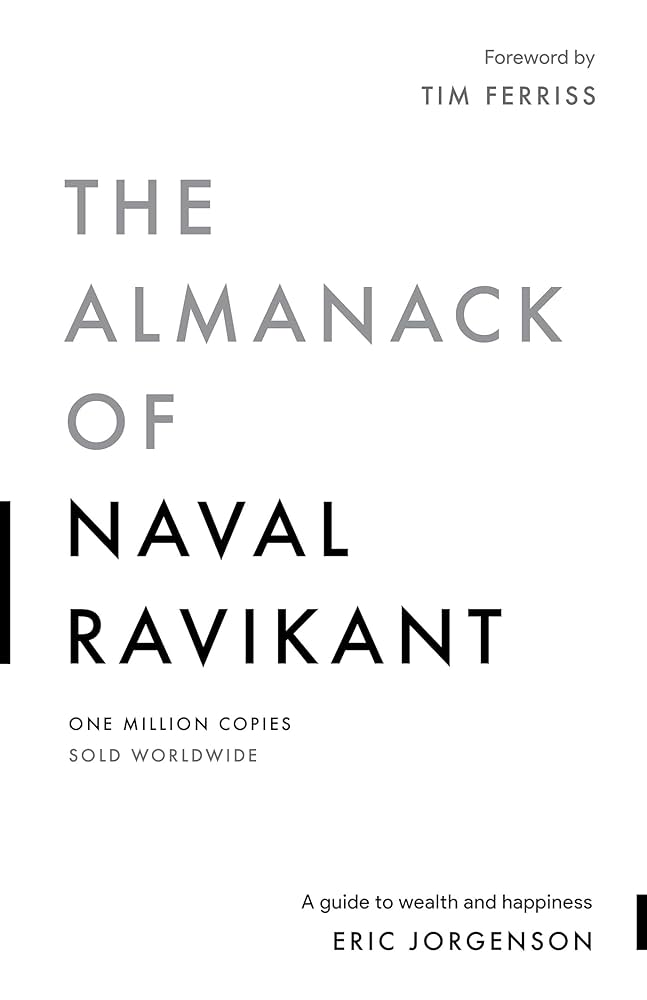
Now that I’m using Reading Refresh to keep myself up to date on books I’ve read in the past, I thought I’d share some of them as they came back up. Today is Eric Jorgenson’s “Almanack of Naval Ravikant“. This book is also available as a free flashcard deck on Ripple Recall.
“The Almanack of Naval Ravikant” was an interesting book. I had heard it was a “must read”, but I wasn’t really sure why. I’d seen a bit of Ravikant’s work over the years, but never dug in too much. After finishing the book, I agree that it’s one you shouldn’t skip.
In the years since I’ve read this book I’ve written many blog posts based on ideas from it, so I’ll share some of those here.
A fuzzy basket of priorities
Basically, whenever you throw any so-called good habit at somebody, they’ll have an excuse for themselves. Usually the most common is “I don’t have time.” “I don’t have time” is just another way of saying “It’s not a priority.” What you really have to do is say whether it is a priority or not. If something is your number one priority, then you will do it. That’s just the way life works. If you’ve got a fuzzy basket of ten or fifteen different priorities, you’re going to end up getting none of them.
As I shared in that post, this is why “I don’t have time” is a bogus excuse; the real issue when you say that phrase is that the item is question is simply not a priority (which is perfectly valid). You have time, and keeping your priorities straight will help you make the most of it.
Clear thinking versus memorization
The really smart thinkers are clear thinkers. They understand the basics at a very, very fundamental level. I would rather understand the basics really well than memorize all kinds of complicated concepts I can’t stitch together and can’t rederive from the basics. If you can’t rederive concepts from the basics as you need them, you’re lost. You’re just memorizing.
I’m a big fan of memorization, as I’ve shared hundreds of times over the years, but memorization alone isn’t enough. You need to be able to wrap that knowledge around the full concept or you really don’t have anything. It’s like the idea that I recently shared regarding Jeopardy champion Victoria Groce; memorization is much more valuable (and easier to do) if you take the time to understand the full concepts.
You have the power that your distant ancestors had
Humans evolved as hunters and gatherers where we all worked for ourselves. It’s only at the beginning of agriculture we became more hierarchical. The Industrial Revolution and factories made us extremely hierarchical because one individual couldn’t necessarily own or build a factory, but now, thanks to the internet, we’re going back to an age where more and more people can work for themselves.
Thanks to technology today, you have the means to run your own life and not necessarily need to work for “the man” if you don’t want to.
Books are a public service
I created this book as a public service. Tweets, podcasts, and interviews quickly get buried and lost. Knowledge this valuable deserves a more permanent, accessible format. That is my mission with this book.
While the other quotes in this post are from Naval himself, this quote was from Eric Jorgenson, explaining why he put this book together. Tweets and podcasts can be great, but they quickly fade away. Eric’s work in compiling this book was a great service for all of us and is something that will last for many years to come.
But it feels like play to you
Building specific knowledge will feel like play to you but will look like work to others.
I love what I do for work, which almost feels unfair. I spend too much of my free time “working” because I enjoy that kind of activity. If you argue that a strict work/life balance is key, I won’t disagree with you, but that doesn’t mean I have any desire to follow it.
A contrarian doesn’t always object
A contrarian isn’t one who always objects—that’s a conformist of a different sort. A contrarian reasons independently from the ground up and resists pressure to conform.
Some people think that being a contrarian means you always object to ideas, but that’s just being rude. A true contrarian thinks independently and often comes to different conclusions. It reminds me a lot of the idea of “disagreeability” when it comes to having high agency.
Your beliefs shouldn’t come in packages
Any belief you took in a package (ex. Democrat, Catholic, American) is suspect and should be re-evaluated from base principles.
It’s only been a year since I first published that post, and it seems things have pushed considerably further in the wrong direction here. What belief that’s often part of your “package” is something you disagree with? Are you a Republican who supports abortion? Are you a Christian who doesn’t believe in hell? Looking at pieces individually will help you shape into someone who can really defend their beliefs compared with someone who believes something because it’s part of the group they belong to.
Building the skill of happiness
How does someone build the skill of happiness? You can build good habits. Not drinking alcohol will keep your mood more stable. Not eating sugar will keep your mood more stable. Not going on Facebook, Snapchat, or Twitter will keep your mood more stable. Playing video games will make you happier in the short run—and I used to be an avid gamer—but in the long run, it could ruin your happiness. You’re being fed dopamine and having dopamine withdrawn from you in these little uncontrollable ways. Caffeine is another one where you trade long term for the short term.
Some people are naturally happier than others, but there are specific things you can do to improve your own happiness (as Ravikant shared in the quote above). If you wish you were a happier person but you spend all day on Twitter between cans of soda, your wish is unlikely to magically come true without a bit of action on your part.
It was indeed a fantastic book, and this post just scratched the surface of it. I encourage you to check it out for yourself, stay fresh with the flashcards for it in Ripple Recall, and watch this short overview video for a bit more: